
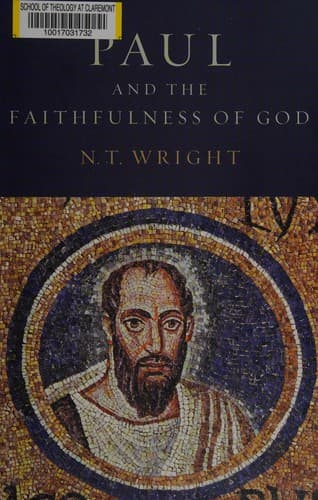
Paul and the Faithfulness of God
بولس وأمانة الله
Paul et la fidélité de Dieu
Editorial summary
Wright's monumental two-volume work represents a comprehensive theological reading of Paul's letters that places the apostle's understanding of God at the center of early Christian thought. The study argues that Paul's theology constitutes a radical reconceptualization of Jewish monotheism through the lens of Jesus Christ and the Spirit, maintaining continuity with Israel's faith while fundamentally transforming it. Wright contends that Paul's God remains the God of Abraham, Isaac, and Jacob, yet this deity's character and purposes are now definitively revealed through the crucified and risen Messiah.
The work employs a multifaceted methodology, combining historical criticism with narrative theology and worldview analysis. Wright situates Paul within first-century Judaism, arguing against both the traditional Lutheran reading that opposes Paul to Judaism and the "new perspective" that minimizes theological distinctiveness. Instead, he presents Paul as a Jewish thinker whose encounter with the risen Jesus necessitates a thoroughgoing revision of Jewish theological categories while maintaining their essential framework. The study examines how Paul reconceives divine action in history, arguing that God's faithfulness to covenant promises finds its climax in Jesus, through whom the deity accomplishes what the Torah could not.
Central to Wright's argument is the claim that Paul develops a nascent trinitarianism through his christologically reconfigured monotheism. The apostle's reformulation includes Jesus within the divine identity while maintaining Jewish monotheism's basic structure. This theological innovation emerges not from Hellenistic influence but from the internal logic of Jewish eschatological hope fulfilled in unexpected ways. Wright demonstrates how Paul's understanding of God's righteousness, covenant faithfulness, and cosmic sovereignty all undergo christological reinterpretation without abandoning their Jewish theological roots.
The work's significance lies in its integration of historical and theological approaches to demonstrate that Paul's God-talk cannot be reduced to either Greek philosophical categories or traditional Jewish theology. Wright shows how Paul's theological innovation creates the conceptual framework for later Christian doctrine while remaining intelligible within its original Jewish matrix. By focusing on divine faithfulness as the organizing principle of Paul's theology, the study illuminates how early Christian thought negotiated the relationship between continuity and discontinuity with Jewish monotheism, providing crucial insights into the emergence of distinctively Christian discourse about God.
Argument formulations engaged
Related works
Wright, N. T. (2013). Paul and the Faithfulness of God. SPCK / Fortress Press.
@book{paul-and-the-faithfulness-of-god-2013,
  author    = {Wright, N. T.},
  title     = {Paul and the Faithfulness of God},
  year      = {2013},
  publisher = {SPCK / Fortress Press},
  url       = {https://god-database.com/en/works/paul-and-the-faithfulness-of-god-2013}
}