
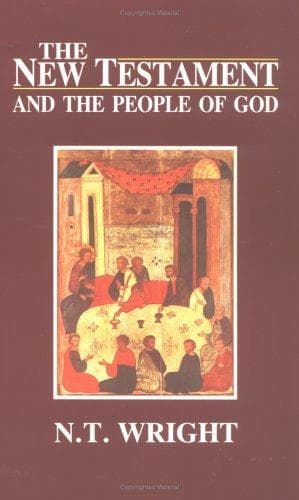
The New Testament and the People of God
العهد الجديد وشعب الله
Le Nouveau Testament et le Peuple de Dieu
Editorial summary
This monograph inaugurates Wright's multi-volume project on Christian origins and the question of God, establishing the methodological foundation for his historical investigation of early Christianity. Wright develops a critical realist epistemology that navigates between naive objectivism and radical postmodern skepticism, arguing that historical knowledge, while provisional, can achieve genuine understanding of past realities. This philosophical framework directly addresses contemporary challenges to religious knowledge claims, particularly those emerging from poststructuralist critiques of historical method.
Wright introduces his distinctive approach through the concept of worldviews as the fundamental level of human understanding, expressed through stories that communities tell about reality. He argues that first-century Judaism constituted a coherent worldview centered on monotheism, election, and eschatology, within which Jesus and early Christianity must be understood. This methodological move challenges both Enlightenment approaches that abstract religious ideas from their historical contexts and existentialist interpretations that dissolve historical particularity into timeless truths.
The work engages extensively with the "Third Quest" for the historical Jesus, positioning itself against both the reductionist tendencies of the Jesus Seminar and traditional approaches that divorce Jesus from his Jewish context. Wright contends that properly understanding Jesus requires grasping how he reinterpreted Israel's foundational narrative in relation to his own mission. This historical argument carries significant theological weight, as Wright maintains that Christianity's truth claims depend upon actual historical events rather than mythological constructs or philosophical principles.
Wright's treatment of early Christian development challenges both conservative Protestant and liberal scholarly paradigms. Against Bultmann's program of demythologization, he argues that the New Testament writers intended to make historical claims about divine action in the world. Against fundamentalist approaches, he insists on rigorous historical-critical method while maintaining that such investigation supports rather than undermines Christian faith.
The monograph's significance lies in its sophisticated integration of philosophical hermeneutics, historical method, and theological reflection. Wright demonstrates that questions about God cannot be separated from questions about history, knowledge, and human understanding. His critical realist approach offers a middle path between fideism and rationalism, arguing that religious knowledge emerges through historically grounded interpretation of communal narratives. This methodological contribution shapes ongoing debates about how historical study relates to theological truth claims and whether academic investigation can legitimately address questions about divine action in history.
Argument formulations engaged
Related works
Wright, N. T. (1992). The New Testament and the People of God. SPCK / Fortress Press.
@book{the-new-testament-and-the-people-of-god-,
  author    = {Wright, N. T.},
  title     = {The New Testament and the People of God},
  year      = {1992},
  publisher = {SPCK / Fortress Press},
  url       = {https://god-database.com/en/works/the-new-testament-and-the-people-of-god-1992}
}