
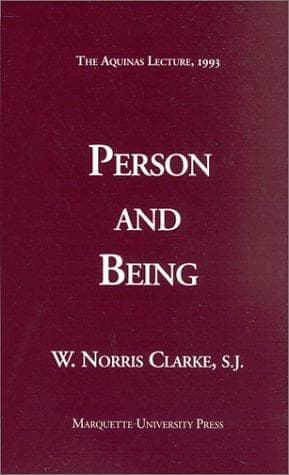
Person and Being
الشخص والوجود
Personne et être
Editorial summary
This monograph presents a systematic reconstruction of Thomistic metaphysics that places the concept of person at the center of philosophical reflection on being. Clarke develops a creative synthesis of traditional Thomistic ontology with insights from personalist philosophy, process thought, and contemporary phenomenology, arguing that personal being represents the highest and most revelatory mode of existence.
The work unfolds in two major movements. First, Clarke articulates a dynamic interpretation of Thomas Aquinas's metaphysics of being, emphasizing that existence (esse) is not static but inherently active and self-communicative. Against interpretations that present Thomistic being as abstract or impersonal, he argues that being manifests itself primordially through action and relation. This reading draws on neglected texts in Aquinas while incorporating insights from process philosophers like Whitehead, though Clarke maintains crucial distinctions between substance and relation that process thought typically dissolves.
Second, the analysis demonstrates how personal being exemplifies this dynamic structure most perfectly. Persons are characterized by self-possession (substance) and self-donation (relation), embodying the fundamental metaphysical principle that "to be is to be in relation." This framework allows Clarke to address classical problems about divine personhood and the Trinity, arguing that far from being anthropomorphic projection, the attribution of personhood to God represents the analogical perfection of what being means.
The monograph engages critically with both neo-scholastic interpretations that overemphasize divine immutability and modern philosophies that reject substantial personhood altogether. Clarke particularly challenges Heidegger's critique of ontotheology, arguing that properly understood Thomistic personalism avoids reducing God to a supreme being among beings. The work also responds to feminist concerns about substance metaphysics by showing how authentic personhood requires reciprocal relation rather than isolated self-sufficiency.
Clarke's contribution lies in demonstrating how classical theistic metaphysics can incorporate legitimate modern insights about subjectivity, relation, and process without abandoning core commitments to divine transcendence and personal immortality. By grounding his analysis in careful textual scholarship while engaging contemporary debates, he provides resources for defending personal theism against both religious fundamentalism and secular reductionism. The work's influence extends beyond Thomistic circles, offering a sophisticated model for how traditional metaphysics can address perennial questions about consciousness, identity, and ultimate reality.
Argument formulations engaged
Clarke, W. Norris (1993). Person and Being. Marquette Univ Pr.
@book{person-and-being-1993,
  author    = {Clarke, W. Norris},
  title     = {Person and Being},
  year      = {1993},
  publisher = {Marquette Univ Pr},
  url       = {https://god-database.com/en/works/person-and-being-1993}
}