
Editorial summary
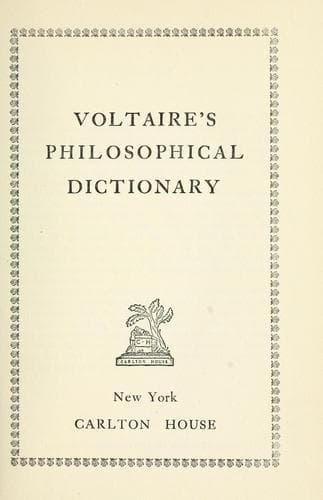
Voltaire's Philosophical Dictionary stands as a landmark assault on religious orthodoxy and clerical authority in Enlightenment Europe. Through approximately 73 alphabetically arranged articles, this work deploys wit, irony, and rational criticism to dismantle traditional theological claims and expose what Voltaire perceives as the absurdities and dangers of organized religion, particularly Christianity.
The Dictionary employs a deliberately fragmentary method that allows Voltaire to attack religious doctrine from multiple angles while evading systematic refutation. Articles range from direct theological topics like "God," "Soul," and "Miracles" to seemingly tangential subjects that become vehicles for religious criticism. Throughout, Voltaire contrasts reason with faith, consistently finding the latter wanting. His article on "Faith," for instance, defines it as belief without evidence, implicitly condemning the epistemological foundations of religious knowledge.
Central to Voltaire's critique is his distinction between natural religion and revealed religion. While acknowledging a supreme being through design arguments, he systematically rejects Christian particularism, biblical authority, and claims of divine intervention. The work relentlessly mocks theological disputes, presenting them as meaningless quarrels that have nonetheless produced centuries of violence and persecution. His treatment of religious intolerance proves especially fierce, linking theological certainty directly to human cruelty.
The Dictionary's significance extends beyond its specific arguments to its method of philosophical combat. By choosing an alphabetical format, Voltaire creates an anti-systematic system that mirrors and subverts traditional religious encyclopedias. This structure enables him to launch guerrilla attacks on orthodoxy while maintaining plausible deniability through irony and indirection. The work's conversational tone and accessible style deliberately democratize philosophical criticism, bringing Enlightenment skepticism to a broader readership than formal philosophical treatises could reach.
Voltaire's contribution to debates about God lies not in original philosophical arguments but in his successful popularization of deistic and skeptical positions. The Dictionary crystallizes Enlightenment challenges to religious authority, scriptural reliability, and theological reasoning. Its influence on subsequent secular thought proves immense, establishing rhetorical strategies and critical perspectives that continue to shape popular religious criticism. The work represents a pivotal moment when philosophical skepticism transformed from elite discourse into a cultural force capable of challenging institutional religious power.
Argument formulations engaged
Related works
Voltaire (1764). Philosophical Dictionary. Bookyards.
@book{philosophical-dictionary-1764,
  author    = {Voltaire},
  title     = {Philosophical Dictionary},
  year      = {1764},
  publisher = {Bookyards},
  url       = {https://god-database.com/en/works/philosophical-dictionary-1764}
}