
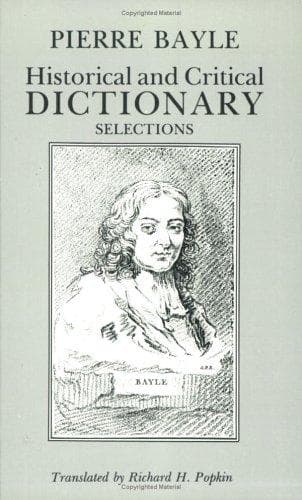
Historical and Critical Dictionary
المعجم التاريخي والنقدي
Dictionnaire historique et critique
Editorial summary
Pierre Bayle's Historical and Critical Dictionary represents a watershed moment in the intellectual history of religious skepticism and the philosophical examination of theological claims. This monumental work, comprising biographical entries accompanied by extensive critical footnotes, ostensibly presents itself as a reference text but functions as a sophisticated vehicle for challenging religious orthodoxy and advancing skeptical arguments about divine revelation, providence, and the compatibility of faith with reason.
Bayle employs a distinctive methodological approach that anticipates later Enlightenment strategies of critique. Through meticulous examination of biblical narratives, theological doctrines, and historical religious claims, he exposes contradictions, moral difficulties, and logical inconsistencies within Christian tradition. His article on David, for instance, scrutinizes the biblical king's moral failings while questioning how such behavior accords with divine favor. Similarly, his treatment of Manichaeism presents dualist explanations of evil as philosophically superior to orthodox theodicies, though he formally maintains Christian allegiance.
The work's significance lies primarily in its systematic demonstration of reason's capacity to undermine religious certainty. Bayle argues that rational examination of religious doctrines inevitably leads to perplexity rather than clarity, suggesting that faith and reason occupy fundamentally incompatible domains. His famous discussions of the problem of evil, particularly in articles on the Paulicians and Zoroastrians, present arguments that later philosophers would recognize as decisive challenges to traditional theism. He contends that the existence of evil remains inexplicable within monotheistic frameworks that posit an omnipotent, benevolent deity.
Writing in the context of post-Reformation religious conflicts and emerging scientific rationalism, Bayle addresses multiple audiences simultaneously. While ostensibly defending Calvinist orthodoxy against Catholic criticism, his deeper target appears to be religious certainty itself. His erudite footnotes, often exceeding the main text in length and philosophical substance, create a labyrinthine argument structure that protects him from direct charges of impiety while advancing profoundly skeptical conclusions.
The Dictionary's lasting contribution to debates about God lies in its demonstration that rigorous historical and philosophical scrutiny undermines confidence in revealed religion. By showing how rational investigation generates doubt rather than certainty about theological matters, Bayle establishes a template for Enlightenment religious criticism. His work suggests that honest intellectual inquiry leads not to atheism but to a thoroughgoing skepticism about humanity's capacity to achieve knowledge of the divine through either reason or revelation.
Argument formulations engaged
Related works
Bayle, Pierre (1697). Historical and Critical Dictionary. Hackett Pub Co.
@book{historical-and-critical-dictionary-1697,
  author    = {Bayle, Pierre},
  title     = {Historical and Critical Dictionary},
  year      = {1697},
  publisher = {Hackett Pub Co},
  url       = {https://god-database.com/en/works/historical-and-critical-dictionary-1697}
}