
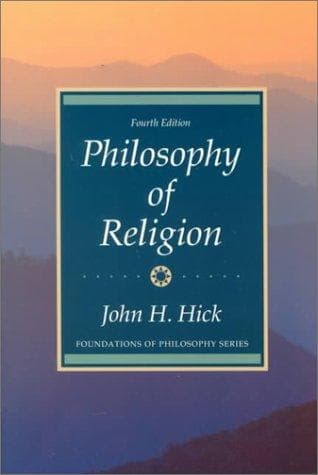
Philosophy of Religion
فلسفة الدين
Philosophie de la religion
Philosophy of religion is a rigorous discipline that examines the rationality of religious belief, the nature of God, the problem of evil, religious language, and the relationship between faith and reason, without dogmatic commitment to any single tradition.
Editorial summary
John Hick's Philosophy of Religion stands as a seminal textbook that systematically examines the central questions surrounding religious belief through the lens of analytic philosophy. The work provides a comprehensive introduction to the field while subtly advancing Hick's distinctive pluralist perspective on religious diversity and truth.
The text methodically addresses three major argument families that dominate contemporary philosophy of religion. In treating the problem of evil, Hick presents both the logical and evidential versions of the argument, carefully analyzing theodicies from Augustine through Plantinga. His discussion reveals how the existence of suffering poses perhaps the most formidable challenge to traditional theism, while also demonstrating the sophisticated responses developed by religious philosophers. The work's examination of the incoherence-of-theism arguments covers classical paradoxes regarding divine attributes, including omnipotence, omniscience, and perfect goodness. Hick presents these challenges with analytical precision while showing how contemporary philosophers have attempted to resolve apparent contradictions through refined conceptual analysis.
Most distinctive is Hick's treatment of eschatological verification, which connects to his broader epistemological concerns about religious knowledge. He explores how religious claims might be verified or falsified in principle, even if not in present experience. This discussion reflects his influential contribution to religious epistemology through his earlier work on eschatological verification as a response to logical positivism's challenge to religious language.
Throughout the text, Hick's pluralist commitments subtly inform his presentation. While maintaining scholarly objectivity appropriate to a textbook, his selection and framing of issues reflect an underlying sympathy toward understanding religious diversity as different cultural responses to the same ultimate reality. This perspective influences his treatment of comparative elements and his attention to non-Western religious traditions alongside Christianity.
The work's significance lies in its successful integration of rigorous analytical method with broad coverage of religious philosophy's central debates. Hick demonstrates how analytical tools can illuminate traditional theological questions while remaining accessible to students. His textbook has shaped generations of scholars by providing a framework that takes religious claims seriously as philosophical propositions while acknowledging the complexity of religious experience and diversity. The work remains influential both as a teaching resource and as a subtle argument for approaching philosophy of religion with both analytical rigor and pluralist openness.
Structured analysis
Argument formulations engaged
Related works
Hick, John Philosophy of Religion.
@book{philosophy-of-religion,
  author    = {Hick, John},
  title     = {Philosophy of Religion},
  year      = {n.d.},
  url       = {https://god-database.com/en/works/philosophy-of-religion}
}