
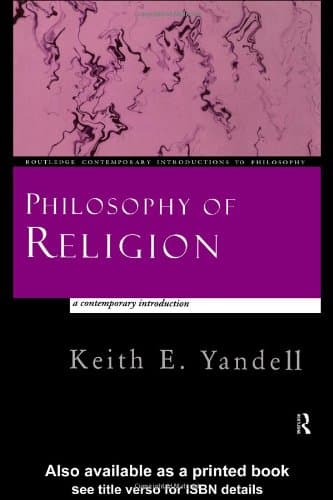
Philosophy of Religion: A Contemporary Introduction
فلسفة الدين: مقدمة معاصرة
Philosophie de la religion : Une introduction contemporaine
Editorial summary
This comprehensive textbook provides a systematic introduction to philosophy of religion through careful analysis of core arguments and positions in the field. Keith Yandell structures the work around fundamental questions concerning religious belief, divine attributes, religious experience, and the relationship between faith and reason. The text examines both theistic and non-theistic perspectives while maintaining analytical rigor throughout its treatment of contested philosophical territory.
Yandell employs a distinctive methodological approach that combines historical exposition with contemporary philosophical analysis. Rather than merely surveying positions, the work engages substantively with arguments for and against theistic belief, examining classical proofs for God's existence alongside modern critiques. The treatment of the ontological, cosmological, and teleological arguments receives particularly thorough attention, with Yandell presenting both traditional formulations and recent developments in modal logic and probability theory. The text also addresses the problem of evil in considerable detail, analyzing various theodicies and defenses while acknowledging the philosophical challenges they face.
A significant contribution of the work lies in its treatment of religious epistemology and the rationality of religious belief. Yandell examines evidentialist challenges to theism, Reformed epistemology's response, and debates over properly basic beliefs. The discussion extends to religious experience as a potential source of justification for religious belief, considering both phenomenological accounts and skeptical objections. The text engages seriously with religious diversity, addressing philosophical problems raised by conflicting truth claims across traditions.
The work situates contemporary debates within their broader intellectual context, tracing connections between current discussions and historical philosophical traditions. Yandell demonstrates how medieval arguments inform modern analytical approaches while showing how contemporary logical tools can clarify traditional problems. The treatment remains philosophically sophisticated while accessible to advanced undergraduate and graduate students.
Throughout, Yandell maintains analytical neutrality while ensuring arguments receive fair representation. The text avoids both uncritical acceptance of religious claims and dismissive skepticism, instead modeling careful philosophical investigation. This balanced approach makes the work valuable for students approaching philosophy of religion from various perspectives. The comprehensive bibliography and suggestions for further reading establish the text as an essential resource for understanding contemporary philosophical engagement with religious questions. By combining historical awareness with analytical precision, Yandell produces a textbook that both introduces key concepts and advances philosophical understanding of fundamental religious questions.
Argument formulations engaged
Related works
Yandell, Keith E. (1999). Philosophy of Religion: A Contemporary Introduction.
@book{philosophy-of-religion-a-contemporary-in,
  author    = {Yandell, Keith E.},
  title     = {Philosophy of Religion: A Contemporary Introduction},
  year      = {1999},
  url       = {https://god-database.com/en/works/philosophy-of-religion-a-contemporary-introduction-1999}
}