
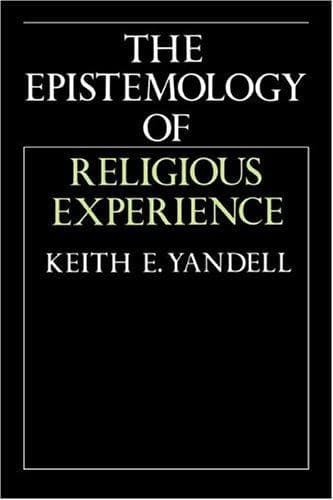
The Epistemology of Religious Experience
إبستمولوجيا التجربة الدينية
L'Épistémologie de l'Expérience Religieuse
Editorial summary
This monograph presents a rigorous philosophical examination of whether religious experiences can serve as legitimate grounds for religious belief. Yandell develops a comprehensive epistemological framework for evaluating the evidential value of religious experiences across diverse traditions, engaging critically with both defenders and critics of experiential justification for theistic belief.
The work begins by establishing precise conceptual distinctions between various types of religious experiences, from sensory phenomena to mystical encounters. Yandell argues that much confusion in debates about religious epistemology stems from inadequate attention to these categorical differences. He proposes a taxonomy that distinguishes between phenomenologically thick experiences (those with specific sensory or quasi-sensory content) and phenomenologically thin experiences (characterized primarily by their noetic quality).
Central to Yandell's analysis is his critique of the principle of credulity advanced by Richard Swinburne and others, which holds that experiential seemings provide prima facie justification for belief absent defeaters. While acknowledging the principle's initial plausibility, Yandell contends that religious experiences face unique epistemological challenges that complicate straightforward application of this principle. He examines problems of religious diversity, arguing that conflicting experiential claims across traditions generate what he terms a "mutual cancellation" problem that weakens the evidential force of any particular religious experience.
The monograph engages substantively with William Alston's perceptual model of mystical experience, offering both appreciation and criticism. Yandell grants that Alston successfully demonstrates the conceptual possibility of reliable experiential access to divine reality but questions whether actual religious experiences meet the conditions necessary for such reliability. He develops original arguments concerning the problem of identifying the object of religious experience and the difficulty of establishing appropriate checking procedures analogous to those available for sensory perception.
Yandell's distinctive contribution lies in his balanced assessment that neither categorically endorses nor dismisses the evidential value of religious experience. He argues that while religious experiences cannot bear the full weight of justifying religious belief independently, they may contribute to cumulative case arguments when combined with other considerations. The work concludes by outlining conditions under which religious experiences might possess genuine evidential force, while maintaining that such experiences alone rarely if ever provide sufficient justification for full-blooded theistic belief. His analysis has influenced subsequent discussions about the relationship between religious experience, rationality, and justified belief formation.
Argument formulations engaged
Related works
Yandell, Keith E. (1993). The Epistemology of Religious Experience. Cambridge University Press.
@book{the-epistemology-of-religious-experience,
  author    = {Yandell, Keith E.},
  title     = {The Epistemology of Religious Experience},
  year      = {1993},
  publisher = {Cambridge University Press},
  url       = {https://god-database.com/en/works/the-epistemology-of-religious-experience-1993}
}