
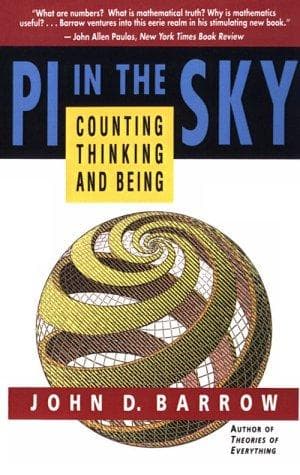
Pi in the Sky: Counting, Thinking, and Being
باي في السماء: العد والتفكير والوجود
Pi dans le ciel : Compter, penser et être
Editorial summary
This work examines the relationship between mathematics, physical reality, and human cognition, offering insights into fundamental questions about the nature of existence and divine design. John D. Barrow explores whether mathematical truths exist independently of human minds and whether the universe's mathematical intelligibility suggests purposeful creation.
Barrow begins by tracing the historical development of counting and mathematical thinking, demonstrating how abstract mathematical concepts emerged from practical human needs. He then examines the peculiar effectiveness of mathematics in describing physical phenomena, engaging with Eugene Wigner's famous puzzle about the "unreasonable effectiveness of mathematics." The author considers whether this correspondence between mathematical structures and physical reality points to an underlying design or merely reflects the evolutionary adaptation of human cognition.
The work addresses several positions in the philosophy of mathematics, including Platonism, formalism, and constructivism. Barrow critically evaluates each stance while examining their implications for understanding reality's fundamental nature. He pays particular attention to the question of whether mathematical truths are discovered or invented, a distinction with significant theological implications. If mathematical truths exist eternally and independently of human minds, this might suggest a transcendent realm of necessary truths traditionally associated with divine intelligence.
Barrow engages with anthropic reasoning, exploring how the universe's mathematical comprehensibility relates to the conditions necessary for conscious observers. He examines whether the fact that humans can understand the universe mathematically provides evidence for design or simply reflects selection effects. The work considers various interpretations of physical constants and their precise values, discussing whether their apparent fine-tuning suggests intentionality.
The author's approach combines technical mathematical exposition with philosophical analysis, making sophisticated arguments accessible to educated non-specialists. He draws on developments in physics, cosmology, and cognitive science to illuminate classical philosophical questions about necessity, contingency, and design. While acknowledging the limits of scientific explanation, Barrow suggests that the universe's mathematical structure raises profound questions about its ultimate ground.
The work contributes to natural theology debates by examining whether mathematical order provides evidence for transcendent purpose. Rather than offering definitive answers, Barrow illuminates the conceptual issues at stake, helping readers understand why the relationship between mathematics and reality remains philosophically significant for questions about God, design, and the nature of existence itself.
Argument formulations engaged
Related works
Barrow, John D. (1992). Pi in the Sky: Counting, Thinking, and Being. Oxford University Press.
@book{pi-in-the-sky-counting-thinking-and-bein,
  author    = {Barrow, John D.},
  title     = {Pi in the Sky: Counting, Thinking, and Being},
  year      = {1992},
  publisher = {Oxford University Press},
  url       = {https://god-database.com/en/works/pi-in-the-sky-counting-thinking-and-being-1992}
}