
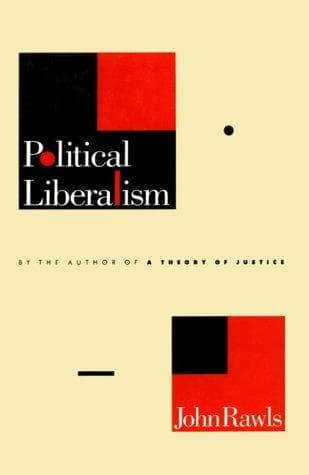
Political Liberalism
الليبرالية السياسية
Libéralisme politique
Editorial summary
This monograph represents Rawls's major revision and defense of his theory of justice in response to critiques of his earlier work. While not explicitly a theological text, Political Liberalism addresses fundamental questions about religious pluralism and the role of comprehensive doctrines, including religious worldviews, in democratic society. Rawls develops his conception of political liberalism as a response to the fact of reasonable pluralism—the recognition that citizens in modern democracies hold incompatible yet reasonable comprehensive doctrines, many of which are religious in nature.
The work's central contribution to debates about God lies in its treatment of how religious beliefs should function in public political discourse. Rawls argues that in a well-ordered society characterized by reasonable pluralism, political principles must be justifiable independently of any particular comprehensive doctrine, whether religious or secular. He introduces the concept of an "overlapping consensus," wherein citizens holding different religious and philosophical views can nonetheless agree on political principles for reasons internal to their own comprehensive doctrines. This framework attempts to show how theists, atheists, and agnostics can participate equally in democratic deliberation without abandoning their deepest convictions.
Rawls develops his earlier distinction between comprehensive liberalism and political liberalism, arguing that the latter does not require citizens to adopt any particular metaphysical or religious stance. He elaborates the idea of public reason, which constrains how religious arguments may be deployed in political justification, particularly regarding constitutional essentials and matters of basic justice. The work engages critically with communitarian critics who argue that liberalism necessarily marginalizes religious perspectives, as well as with those who claim that excluding religious reasons from public deliberation is itself a form of philosophical sectarianism.
The monograph's significance for philosophy of religion extends beyond political theory proper. Rawls's account of reasonable disagreement provides a framework for understanding religious diversity that avoids both relativism and dogmatism. His analysis suggests that the persistence of religious disagreement in free societies reflects the "burdens of judgment" rather than irrationality or bad faith. This approach offers a distinctive perspective on religious epistemology and the social dimensions of belief. While some critics argue that Rawls's framework implicitly favors secular over religious worldviews, his theory attempts to remain neutral between theistic and atheistic comprehensive doctrines, focusing instead on the political values all reasonable citizens can endorse.
Argument formulations engaged
Related works
Rawls, John (1993). Political Liberalism.
@book{political-liberalism-1993,
  author    = {Rawls, John},
  title     = {Political Liberalism},
  year      = {1993},
  url       = {https://god-database.com/en/works/political-liberalism-1993}
}