
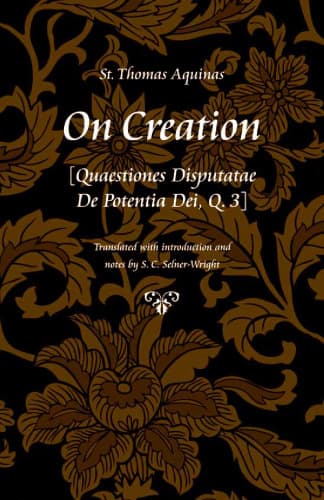
Quaestiones Disputatae de Potentia Dei
مسائل مختلف فيها حول قدرة الله
Questions disputées sur la puissance de Dieu
Editorial summary
This medieval scholastic work represents Aquinas's mature exploration of divine power through the disputed question format characteristic of thirteenth-century university theology. Comprising ten questions with numerous articles each, De Potentia Dei systematically examines God's power in relation to creation, causation, and divine operations. The work demonstrates Aquinas's distinctive synthesis of Aristotelian philosophy with Christian doctrine, addressing contemporary debates within the University of Paris concerning the relationship between divine omnipotence and natural causation.
The treatise begins by establishing God's active power as identical with the divine essence while distinguishing its various aspects through reason. Aquinas argues that divine power operates through both immediate creation ex nihilo and mediated causation through secondary causes, thereby rejecting both Islamic occasionalism and radical Aristotelianism. His analysis carefully navigates between affirming God's absolute power to act beyond the established order and maintaining the integrity of created natures. This balance proves crucial for defending divine freedom against Greek necessitarianism while preserving genuine causal efficacy in creatures.
Central to Aquinas's argument is his treatment of divine simplicity and its compatibility with God's multiple operations. He demonstrates how God's single, eternal act can produce diverse temporal effects without introducing composition into the divine nature. The work engages critically with Avicenna's emanationism and Averroes's determinism, offering a distinctly Christian account of how infinite power creates and sustains finite beings without compromising their proper activities.
The disputed questions format allows Aquinas to address objections from various philosophical schools while developing his positive doctrine. Each article presents opposing arguments, a contrary authority, Aquinas's resolution, and responses to objections. This method reveals the work's pedagogical function within medieval university culture while showcasing rigorous philosophical argumentation.
De Potentia Dei significantly influenced subsequent debates on divine action, miracles, and providence. Its careful distinctions between God's absolute and ordained power shaped later medieval discussions of divine freedom and natural law. The treatise remains valuable for understanding how classical theism reconciles divine transcendence with immanent causation, offering sophisticated responses to both deistic and pantheistic alternatives. Modern scholars recognize it as essential for grasping Aquinas's mature metaphysics of participation and his nuanced account of the God-world relationship.
Argument formulations engaged
Related works
Aquinas, Thomas (1265). Quaestiones Disputatae de Potentia Dei. Catholic Univ of Amer Pr.
@book{quaestiones-disputatae-de-potentia-dei-1,
  author    = {Aquinas, Thomas},
  title     = {Quaestiones Disputatae de Potentia Dei},
  year      = {1265},
  publisher = {Catholic Univ of Amer Pr},
  url       = {https://god-database.com/en/works/quaestiones-disputatae-de-potentia-dei-1265}
}