
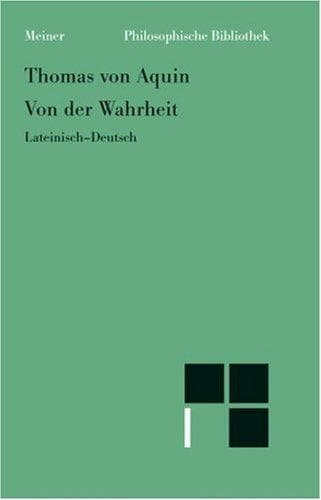
Quaestiones Disputatae de Veritate
مسائل مختلف فيها حول الحقيقة
Questions disputées sur la vérité
Editorial summary
Thomas Aquinas's Quaestiones Disputatae de Veritate represents a pivotal scholastic examination of truth that fundamentally shapes medieval approaches to divine knowledge and the relationship between human understanding and God. Composed during his first Parisian regency between 1256 and 1259, this work employs the disputed question format characteristic of university pedagogy, wherein Aquinas systematically presents objections, counterarguments, and resolutions to establish theological and philosophical conclusions.
The text comprises twenty-nine questions addressing truth's nature, divine knowledge, providence, and the human soul's cognitive capacities. Aquinas develops his correspondence theory of truth, arguing that truth consists in the adequation of intellect and thing (adequatio intellectus et rei). This framework proves crucial for establishing how human beings can attain genuine knowledge of God despite the infinite disparity between created and divine intellects. Against both skeptical positions that deny meaningful God-talk and mystical approaches that bypass rational inquiry, Aquinas defends the possibility of analogical predication about divine attributes.
Central to the work's theological significance is Aquinas's treatment of divine ideas and God's knowledge of creatures. He argues that God knows all things through His essence, which contains the exemplar forms of all possible beings. This position synthesizes Aristotelian epistemology with Augustinian illumination theory, demonstrating how Greek philosophical categories can serve Christian theological purposes without compromising either philosophical rigor or religious orthodoxy.
The text engages critically with Islamic philosophers, particularly Avicenna's necessitarianism and Averroes's theory of the unity of the intellect. Against these positions, Aquinas maintains both divine freedom in creation and individual human immortality, securing foundations essential to Christian doctrine. His arguments concerning prophetic knowledge and divine revelation establish how supernatural truth complements without contradicting natural reason.
Methodologically, De Veritate exemplifies the scholastic commitment to dialectical reasoning while addressing perennial questions about religious epistemology. The work's influence extends through subsequent debates about natural theology, shaping discussions from late medieval nominalism through contemporary analytic philosophy of religion. Its systematic treatment of how finite minds can apprehend infinite truth remains foundational for theistic philosophy, providing sophisticated responses to challenges regarding religious language and knowledge claims about transcendent reality.
Argument formulations engaged
Related works
Aquinas, Thomas (1259). Quaestiones Disputatae de Veritate. Cke Editions.
@book{quaestiones-disputatae-de-veritate-1259,
  author    = {Aquinas, Thomas},
  title     = {Quaestiones Disputatae de Veritate},
  year      = {1259},
  publisher = {Cke Editions},
  url       = {https://god-database.com/en/works/quaestiones-disputatae-de-veritate-1259}
}