
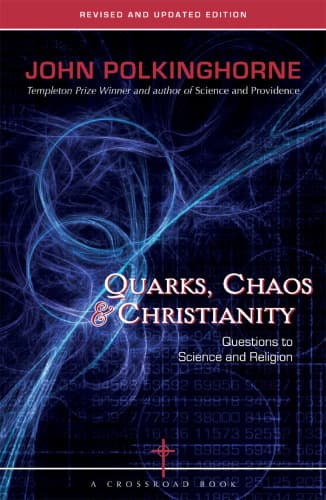
Quarks, Chaos and Christianity
الكواركات والفوضى والمسيحية
Quarks, chaos et christianisme
Editorial summary
This accessible work represents physicist-theologian John Polkinghorne's systematic attempt to demonstrate the compatibility between contemporary science and Christian faith. Writing for a general audience, Polkinghorne draws on his distinguished career in theoretical physics to argue that modern scientific discoveries, far from undermining religious belief, actually provide fresh perspectives on traditional theological questions.
The book's central thesis challenges the widespread assumption that science and religion occupy separate, incompatible domains. Polkinghorne rejects both scientific materialism and religious fundamentalism, proposing instead a unified vision of reality where scientific and theological insights complement rather than contradict each other. He develops this argument through careful examination of key areas where science and faith intersect: quantum mechanics, chaos theory, cosmology, and evolutionary biology.
Polkinghorne's approach combines scientific rigor with theological sophistication. He explains how quantum indeterminacy challenges mechanistic determinism, creating conceptual space for divine action without violating natural laws. His discussion of chaos theory suggests that apparent randomness in nature may conceal deeper patterns of meaning. The anthropic principle in cosmology, he argues, points toward purposeful design rather than cosmic accident. Throughout, he maintains that science describes the processes of creation while theology addresses questions of meaning and purpose.
The work engages critically with both scientific atheists and fellow Christians who reject modern science. Against reductionist materialists like Richard Dawkins, Polkinghorne demonstrates that science itself points beyond purely physical explanations. To conservative Christians suspicious of evolution or modern physics, he shows how these discoveries enrich rather than threaten faith. His nuanced position acknowledges the autonomy of scientific inquiry while insisting that science alone cannot answer ultimate questions about existence, value, and purpose.
Polkinghorne's contribution lies in modeling how scientifically informed believers can engage contemporary thought without compromising either intellectual integrity or religious commitment. His dual expertise as research physicist and Anglican priest lends unique authority to his arguments. The book's significance extends beyond academic theology, offering educated believers a framework for integrating scientific knowledge with religious faith. By showing that acceptance of modern science need not entail atheism, Polkinghorne opens space for dialogue between scientific and religious communities, contributing to broader cultural conversations about the relationship between empirical knowledge and spiritual understanding.
Argument formulations engaged
Related works
Polkinghorne, John C. (1994). Quarks, Chaos and Christianity. SPCK.
@book{quarks-chaos-and-christianity-1994,
  author    = {Polkinghorne, John C.},
  title     = {Quarks, Chaos and Christianity},
  year      = {1994},
  publisher = {SPCK},
  url       = {https://god-database.com/en/works/quarks-chaos-and-christianity-1994}
}