
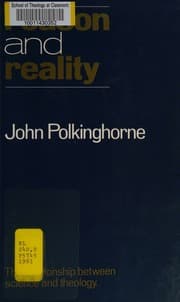
Reason and Reality: The Relationship Between Science and Theology
العقل والواقع: العلاقة بين العلم واللاهوت
Raison et réalité : La relation entre science et théologie
Editorial summary
John Polkinghorne's "Reason and Reality" represents a significant intervention in the science-theology dialogue from a perspective uniquely informed by the author's dual career as theoretical physicist and Anglican priest. The monograph argues for a fundamental compatibility between scientific and theological inquiry, challenging both scientific reductionism and theological fundamentalism while proposing a critical realist framework that can accommodate both domains of knowledge.
Polkinghorne develops his argument through careful examination of how both science and theology function as rational activities seeking to understand reality. He contends that science's spectacular success should not blind us to its inherent limitations, particularly when addressing questions of meaning, purpose, and ultimate reality. The work systematically demonstrates how quantum physics, with its inherent uncertainties and observer-dependent phenomena, has already moved beyond mechanistic determinism, opening conceptual space for theological reflection on divine action.
The author's method combines philosophical analysis with concrete examples from contemporary physics, particularly quantum mechanics and chaos theory. He argues that science itself relies on metaphysical commitments—such as the intelligibility of the universe and the reliability of mathematics—that cannot be justified within science alone. This observation forms the basis for his claim that theology, properly understood, represents a legitimate extension of the human quest for understanding rather than an irrational departure from it.
Against both atheistic scientists who dismiss religion as prescientific superstition and theologians who retreat into fideism, Polkinghorne articulates a position of "critical realism" applicable to both disciplines. He maintains that while science excels at answering "how" questions about natural processes, theology addresses complementary "why" questions about purpose and meaning. The work challenges Enlightenment assumptions about the incompatibility of faith and reason, arguing instead for their mutual enrichment.
The monograph's significance lies in its sophisticated treatment of methodological parallels between scientific and theological inquiry. Polkinghorne demonstrates how both disciplines involve creative interpretation of experience, employ models and metaphors, and require personal judgment in theory selection. His insider's knowledge of theoretical physics lends particular authority to his critique of scientific imperialism. The work has proven influential in establishing intellectual respectability for dialogue between science and religion, offering a nuanced alternative to both conflict and independence models of their relationship.
Argument formulations engaged
Related works
Polkinghorne, John C. (1991). Reason and Reality: The Relationship Between Science and Theology. SPCK.
@book{reason-and-reality-the-relationship-betw,
  author    = {Polkinghorne, John C.},
  title     = {Reason and Reality: The Relationship Between Science and Theology},
  year      = {1991},
  publisher = {SPCK},
  url       = {https://god-database.com/en/works/reason-and-reality-the-relationship-between-science-and-theology-1991}
}