
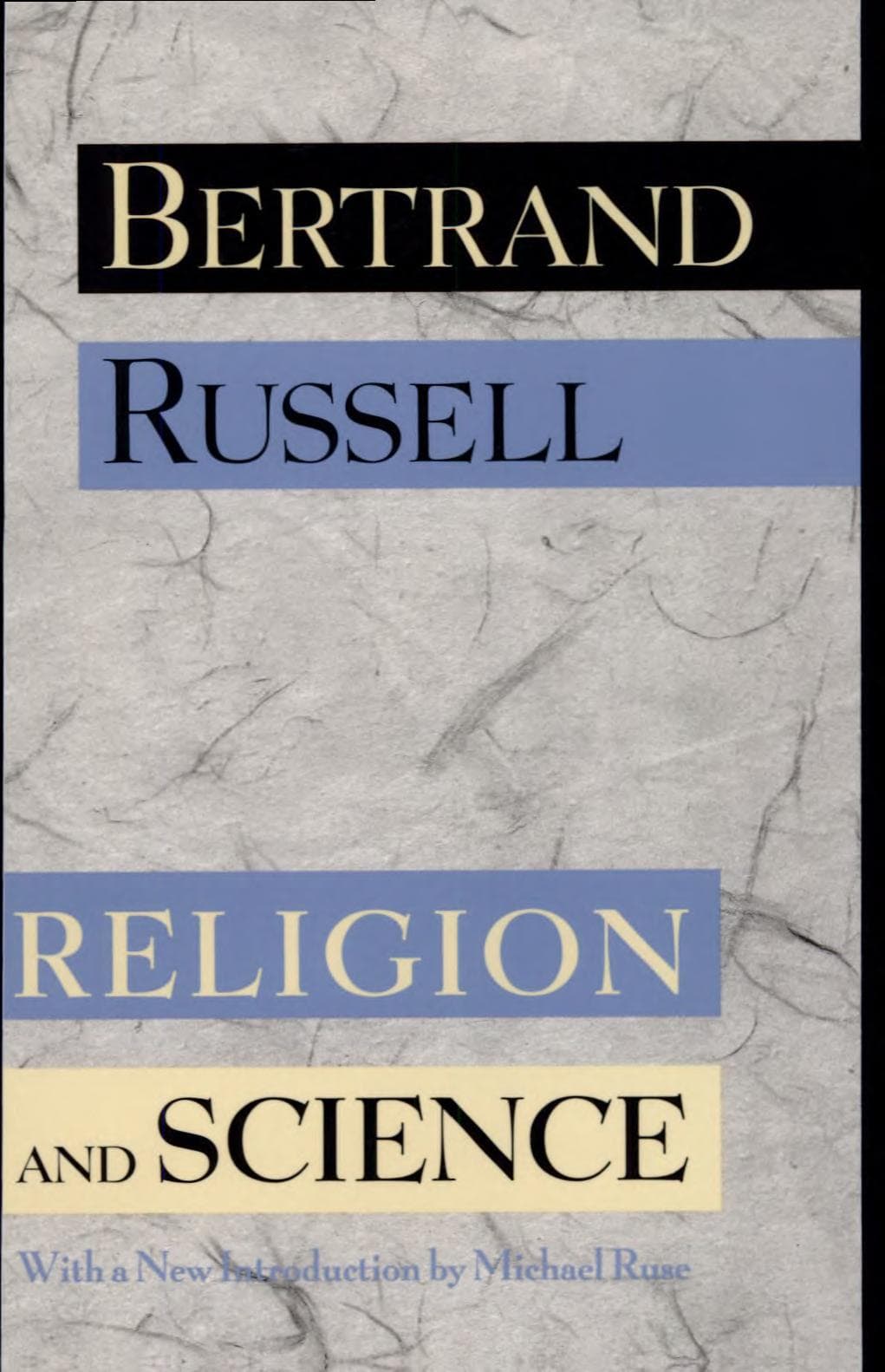
Religion and Science
الدين والعلم
Religion et science
Science and religion represent fundamentally opposed ways of knowing, and the historical conflict between them reveals that religious claims about the world consistently yield ground to scientific inquiry.
Editorial summary
Bertrand Russell's "Religion and Science" presents a systematic examination of the historical and philosophical tensions between religious belief and scientific inquiry. Writing within the secular-naturalist tradition, Russell employs the tools of analytic philosophy to dissect various arguments for theism while defending the superiority of scientific method as a means of understanding reality.
The work traces the progressive retreat of religious explanations in the face of advancing scientific knowledge. Russell argues that religion has consistently lost ground whenever it has made empirically testable claims about the natural world, from cosmology to biology to psychology. He contends that this pattern reveals a fundamental incompatibility between the methods of faith and those of rational inquiry. Where religion relies on authority, revelation, and tradition, science depends on observation, experimentation, and the willingness to revise beliefs based on evidence.
Russell engages directly with the cosmological argument, analyzing various formulations that attempt to prove God's existence from the nature of causation or the contingency of the universe. He argues that these arguments suffer from logical flaws, particularly the arbitrary termination of causal chains at a divine first cause. Why, Russell asks, should the universe require a cause if God does not? His treatment anticipates later discussions about the possibility of self-explanatory or necessarily existing entities.
The problem of evil receives substantial attention as Russell examines theodicies that attempt to reconcile omnipotent benevolence with observable suffering. He finds these explanations unconvincing, arguing that they either diminish divine attributes or trivialize human suffering. Russell particularly criticizes arguments that invoke mysterious divine purposes or the necessity of free will, viewing them as ad hoc solutions that sacrifice intellectual integrity to preserve religious belief.
Throughout the work, Russell's methodology reflects his commitment to logical analysis and empirical grounding. He dissects arguments with precision while maintaining accessibility, demonstrating how philosophical rigor can illuminate public debates about religion. His approach influenced subsequent analytic philosophy of religion, establishing standards for clarity and argumentation that continue to shape the field. The monograph stands as a significant contribution to 20th century secular thought, articulating a vision of human knowledge liberated from theological constraints while acknowledging the psychological and social functions that religion has historically served.
Structured analysis
Argument formulations engaged
Related works
Russell, Bertrand (1974). Religion and Science.
@book{religion-and-science,
  author    = {Russell, Bertrand},
  title     = {Religion and Science},
  year      = {1974},
  url       = {https://god-database.com/en/works/religion-and-science}
}