
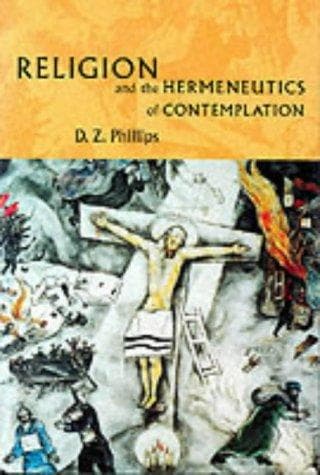
Religion and the Hermeneutics of Contemplation
الدين وتأويليات التأمل
Religion et l'herméneutique de la contemplation
Editorial summary
This monograph represents Phillips's mature statement on the philosophy of religion, advancing his distinctive Wittgensteinian approach to religious belief and practice. The work systematically challenges prevailing philosophical methods that treat religion as a theoretical system requiring justification through evidence or rational argument. Phillips contends that such approaches fundamentally misunderstand the nature of religious discourse and practice.
Central to Phillips's argument is the concept of "contemplative philosophy," which he contrasts with explanatory or justificatory approaches to religion. Rather than asking whether religious beliefs are true or false in a theoretical sense, contemplative philosophy attends to the actual grammar of religious language and the forms of life in which such language is embedded. Phillips argues that religious beliefs are not hypotheses about metaphysical states of affairs but rather expressions of spiritual attitudes and ways of seeing the world that cannot be assessed by external rational criteria.
The work engages critically with several major figures in contemporary philosophy of religion. Phillips challenges Richard Swinburne's probabilistic arguments for theism, arguing that treating God's existence as a hypothesis to be confirmed by evidence betrays a fundamental category mistake. He similarly critiques Alvin Plantinga's reformed epistemology, suggesting that Plantinga's defense of religious belief as properly basic still operates within an evidentialist framework that misunderstands religious commitment. Phillips also addresses John Hick's religious pluralism, arguing that Hick's attempt to find common ground among religions through reference to "the Real" imposes an alien theoretical framework on diverse religious practices.
Phillips develops his positive account through careful attention to religious language in its living contexts. He examines how believers speak of God, prayer, immortality, and religious experience, showing that these concepts function differently from their apparent counterparts in non-religious discourse. The reality of God, for instance, is not a matter of God's existence as a supreme being but rather concerns the role that God-talk plays in believers' lives and the possibilities it opens for human transformation.
The monograph's significance lies in its sustained challenge to the dominant paradigms in analytical philosophy of religion. By insisting that philosophy should contemplate rather than explain religious phenomena, Phillips opens space for understanding religion on its own terms rather than subjecting it to alien standards of rationality. His work continues to influence debates about the proper methods and aims of philosophy of religion.
Argument formulations engaged
Phillips, Dewi Zephaniah (2001). Religion and the Hermeneutics of Contemplation. Cambridge University Press.
@book{religion-and-the-hermeneutics-of-contemp,
  author    = {Phillips, Dewi Zephaniah},
  title     = {Religion and the Hermeneutics of Contemplation},
  year      = {2001},
  publisher = {Cambridge University Press},
  url       = {https://god-database.com/en/works/religion-and-the-hermeneutics-of-contemplation-2001}
}