
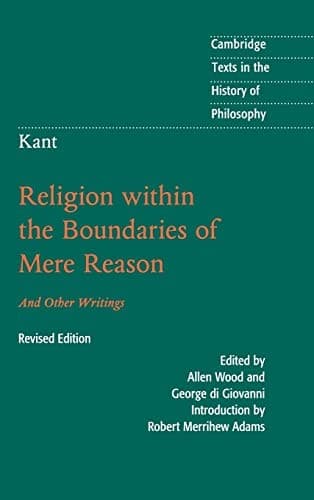
Religion within the Boundaries of Mere Reason
الدين في حدود العقل المحض
La religion dans les limites de la simple raison
Editorial summary
Kant's Religion within the Boundaries of Mere Reason represents a pivotal attempt to reconcile moral philosophy with religious belief through the lens of practical reason. Written in 1793 during increasing censorship of religious discourse, this work examines what rational grounds exist for religious concepts when stripped of supernatural claims and ecclesiastical authority.
The text argues that while theoretical reason cannot prove God's existence, practical reason necessarily postulates God as the guarantor of the highest good—the union of virtue and happiness. Kant contends that moral law, which commands categorically through reason alone, requires belief in divine justice to ensure that virtue ultimately aligns with proportionate happiness, even if not in this life. This moral argument for God differs radically from traditional metaphysical proofs, grounding religious belief in ethical necessity rather than speculative theology.
Central to Kant's analysis is his distinction between historical faith and rational religion. He systematically critiques ecclesiastical Christianity's emphasis on revelation, miracles, and external observances, arguing these represent merely the "vehicle" for moral religion rather than its essence. True religion, for Kant, consists solely in moral conduct performed from duty. He reinterprets core Christian doctrines—original sin, redemption, grace—as symbolic representations of moral truths accessible through reason: the radical evil in human nature, the possibility of moral regeneration, and the incomprehensible assistance needed for moral transformation.
The work directly challenges both orthodox Christianity and Enlightenment deism. Against orthodoxy, Kant denies that salvation depends on historical beliefs or ritual practices. Against deistic rationalism, he maintains that pure reason alone cannot motivate moral transformation without the practical postulates of God and immortality. His position stakes out distinctive middle ground: religion remains necessary for the highest good, but only insofar as it serves moral ends discoverable through reason.
Kant's contribution fundamentally reshapes debates about God by shifting focus from metaphysical speculation to practical necessity. By arguing that moral law itself demands belief in divine justice, he provides a rational foundation for theism that bypasses traditional proofs while avoiding both dogmatic faith and skeptical rejection. This moral argument continues to influence contemporary philosophy of religion, particularly discussions of whether ethics requires theological grounding and how religious concepts might retain meaning within naturalistic frameworks.
Argument formulations engaged
Related works
Kant, Immanuel (1793). Religion within the Boundaries of Mere Reason.
@book{religion-within-the-boundaries-of-mere-r,
  author    = {Kant, Immanuel},
  title     = {Religion within the Boundaries of Mere Reason},
  year      = {1793},
  url       = {https://god-database.com/en/works/religion-within-the-boundaries-of-mere-reason-1793}
}