
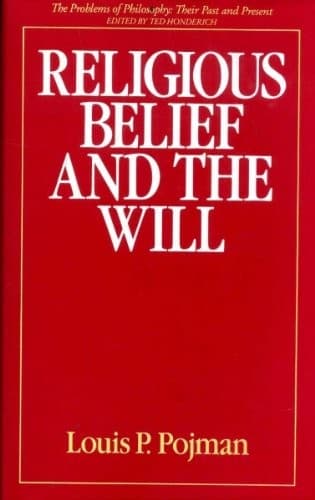
Religious Belief and the Will
الاعتقاد الديني والإرادة
Croyance religieuse et volonté
Editorial summary
This monograph examines the complex relationship between volition and religious belief, challenging both strong doxastic voluntarism and its complete denial. Pojman develops a nuanced position that acknowledges limited volitional influence on belief formation while maintaining that beliefs themselves remain fundamentally non-voluntary. The work engages critically with figures from Pascal and William James to contemporary epistemologists, offering a middle path in debates about faith, reason, and the will.
The study begins by distinguishing direct from indirect voluntarism. While Pojman rejects the possibility of willing beliefs directly into existence, he argues that individuals can undertake various indirect strategies that influence belief formation. These include selective exposure to evidence, cultivation of emotional dispositions, participation in religious practices, and imaginative engagement with religious narratives. His analysis draws on psychological research demonstrating how actions and practices can gradually shape cognitive commitments, even when beliefs themselves cannot be adopted at will.
Central to Pojman's argument is his critique of Pascalian wagering and Jamesian will-to-believe doctrines. He contends that while Pascal correctly identifies prudential reasons for seeking religious belief, the wager fails because one cannot simply choose to believe for pragmatic purposes. Similarly, James's permissive approach to belief in forced, living, momentous options overlooks the involuntary nature of genuine conviction. Pojman argues that both positions conflate the rationality of seeking belief with the possibility of directly willing it.
The monograph's philosophical significance lies in its careful delineation of what volitional control means for religious epistemology. Pojman demonstrates that acknowledging indirect voluntary influence need not collapse into relativism or undermine rational belief assessment. His position preserves the integrity of evidence-based belief formation while recognizing the complex psychological and social factors that shape religious conviction. This framework proves particularly valuable for understanding conversion experiences, religious education, and the gradual development or loss of faith.
The work's lasting contribution involves reframing debates about faith and reason. Rather than viewing voluntary and involuntary aspects of belief as mutually exclusive, Pojman shows how they interact in complex ways. His analysis provides resources for understanding religious commitment that avoid both crude voluntarism and overly intellectualist accounts of faith. The monograph thus offers a sophisticated framework for analyzing how religious beliefs emerge, develop, and change within the constraints of human psychology and rational reflection.
Argument formulations engaged
Pojman, Louis P. (1986). Religious Belief and the Will. Routledge & Kegan Paul.
@book{religious-belief-and-the-will-1986,
  author    = {Pojman, Louis P.},
  title     = {Religious Belief and the Will},
  year      = {1986},
  publisher = {Routledge & Kegan Paul},
  url       = {https://god-database.com/en/works/religious-belief-and-the-will-1986}
}