
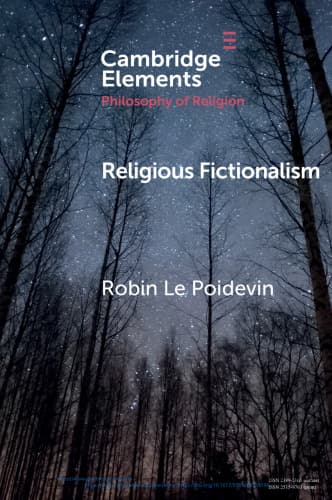
Religious Fictionalism
الخيالية الدينية
Fictionnalisme religieux
Editorial summary
This monograph presents a systematic defense of religious fictionalism as a viable alternative to both theistic belief and atheistic rejection of religious practice. Le Poidevin argues that one can meaningfully engage with religious traditions while treating their theological content as useful fiction rather than literal truth. The work positions itself against both traditional theism, which demands belief in God's existence, and eliminationative atheism, which typically advocates abandoning religious practice altogether.
The central thesis maintains that religious discourse and practice can be preserved through a fictionalist interpretation, wherein participants engage with religious narratives, rituals, and communities while understanding these elements as sophisticated fictions that serve important psychological, moral, and social functions. Le Poidevin draws on contemporary philosophy of fiction to develop a framework showing how religious statements can be meaningful and even truth-apt within their fictional context without requiring belief in their literal truth.
The work engages critically with several philosophical traditions. Against theological realism, Le Poidevin argues that the benefits of religious life do not depend on the actual existence of God or other supernatural entities. Against error theory, which treats all religious claims as false, the fictionalist approach allows for a more nuanced engagement that preserves religious practice while avoiding ontological commitments. The author also addresses expressivist and instrumentalist interpretations of religion, arguing that fictionalism better captures how religious language actually functions.
Le Poidevin employs analytic philosophical methods throughout, examining the logical structure of religious discourse and the pragmatics of religious practice. The work includes detailed analysis of specific religious activities such as prayer, worship, and moral instruction, demonstrating how these can retain their significance under a fictionalist interpretation. Particular attention is given to the phenomenology of religious experience and whether fictionalist engagement can replicate the psychological benefits traditionally associated with genuine belief.
The monograph makes an important contribution to contemporary philosophy of religion by offering a middle path between belief and complete rejection of religion. It provides sophisticated responses to objections that fictionalism renders religion inauthentic or psychologically impossible, drawing on empirical research about imagination, emotion, and ritual behavior. The work has significant implications for debates about the future of religion in secular societies, suggesting that religious traditions might persist and even flourish without literal belief in their theological claims.
Argument formulations engaged
Le Poidevin, Robin (2019). Religious Fictionalism. Cambridge University Press.
@book{religious-fictionalism-2019,
  author    = {Le Poidevin, Robin},
  title     = {Religious Fictionalism},
  year      = {2019},
  publisher = {Cambridge University Press},
  url       = {https://god-database.com/en/works/religious-fictionalism-2019}
}