
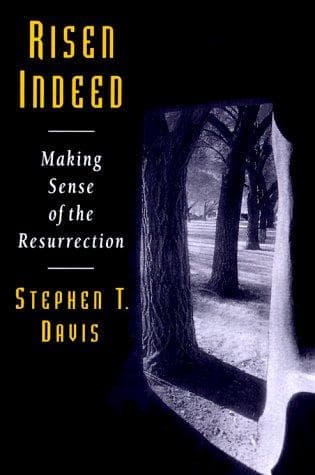
Risen Indeed
قام حقاً
Vraiment ressuscité
Editorial summary
This monograph presents a systematic philosophical defense of the Christian doctrine of bodily resurrection, examining both the resurrection of Jesus Christ and the general resurrection of believers. Davis engages critically with contemporary philosophical and theological challenges to resurrection belief, particularly those emerging from naturalistic worldviews and historical-critical biblical scholarship. His approach combines analytic philosophy with biblical exegesis to construct a case for the coherence and plausibility of resurrection as a divine act.
The work addresses several interconnected philosophical problems surrounding resurrection belief. Davis examines the mind-body problem as it relates to personal identity across death, arguing that bodily resurrection provides a more satisfactory account of post-mortem survival than competing theories of disembodied existence or immediate resurrection. He defends a position he terms "temporary disembodiment," wherein persons exist as disembodied souls between death and resurrection while maintaining that full human personhood requires eventual bodily reconstitution.
Against naturalistic critics who dismiss resurrection as scientifically impossible, Davis develops a nuanced account of miracles that distinguishes between natural impossibility and logical impossibility. He contends that resurrection, while naturally impossible, remains logically possible given divine agency. This argument engages with Humean skepticism about miracles while drawing on contemporary philosophy of science to challenge overly restrictive conceptions of natural law.
The monograph devotes substantial attention to historical arguments surrounding Jesus's resurrection, critically examining both maximalist and minimalist approaches to the biblical evidence. Davis responds to scholars like John Hick and Maurice Wiles who propose non-physical interpretations of resurrection, arguing that such views fail to account adequately for the early Christian testimony and empty tomb traditions. He defends a "moderate" historical approach that acknowledges limitations in historical method while maintaining that resurrection offers the best explanation for the available evidence.
Davis's contribution to the God debate lies in his sophisticated treatment of resurrection as both a philosophical concept and historical claim. By addressing epistemological, metaphysical, and historical dimensions of resurrection belief, he demonstrates how this doctrine functions as a crucial test case for theistic versus naturalistic worldviews. His work challenges both religious believers who minimize bodily resurrection's importance and skeptics who dismiss it as inherently irrational, proposing instead that resurrection belief, properly understood, remains intellectually defensible within a theistic framework.
Argument formulations engaged
Related works
Davis, Stephen T. (1993). Risen Indeed.
@book{risen-indeed-1993,
  author    = {Davis, Stephen T.},
  title     = {Risen Indeed},
  year      = {1993},
  url       = {https://god-database.com/en/works/risen-indeed-1993}
}