
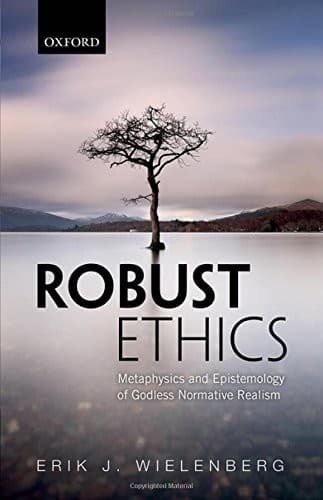
Robust Ethics
الأخلاق القوية
Éthique robuste
Editorial summary
Wielenberg's Robust Ethics presents a systematic defense of non-theistic robust moral realism, arguing that objective moral truths exist as brute facts requiring neither divine grounding nor natural reduction. The work directly challenges both theistic metaethics and secular anti-realist positions, proposing instead that certain moral properties and facts exist necessarily and independently of any foundation beyond themselves.
The monograph's central thesis contends that fundamental ethical truths possess the same ontological status as mathematical or logical truths—they simply exist as features of reality without requiring explanation through more basic facts. Wielenberg develops this position through careful engagement with contemporary metaethical debates, particularly responding to theistic critics who argue that objective morality requires divine grounding. He systematically examines and rejects various dependency theses, including the claims that moral properties must be grounded in divine commands, divine nature, or any supernatural foundation.
Wielenberg's methodology combines analytic philosophy with substantive ethical theory. He constructs detailed arguments against divine command theory and modified divine nature theories, demonstrating how his robust realism can account for moral knowledge, moral motivation, and the apparent universality of certain moral truths without invoking theological premises. The work engages extensively with prominent theistic philosophers including Robert Adams, William Lane Craig, and C. Stephen Evans, offering sophisticated rebuttals to their arguments that morality requires theological foundations.
A distinctive contribution lies in Wielenberg's development of "making" relations—non-causal connections between natural and moral properties that explain moral supervenience without reduction. This framework allows him to maintain both moral objectivity and naturalistic compatibility while avoiding the grounding problems he identifies in theistic accounts. The monograph also addresses evolutionary debunking arguments, showing how moral knowledge remains possible even if our moral faculties developed through natural selection.
The work's significance extends beyond metaethics to broader discussions about secularism and value. By defending robust moral realism without theological commitments, Wielenberg provides crucial philosophical support for secular ethics, demonstrating that rejecting theism need not entail moral anti-realism or nihilism. His arguments contribute substantially to contemporary debates about whether morality requires religious foundations, offering atheistic philosophers sophisticated tools for defending objective ethics while challenging the widespread assumption that moral objectivity depends upon divine existence or activity.
Argument formulations engaged
Related works
Wielenberg, Erik (2014). Robust Ethics. Oxford University Press.
@book{robust-ethics-2014,
  author    = {Wielenberg, Erik},
  title     = {Robust Ethics},
  year      = {2014},
  publisher = {Oxford University Press},
  url       = {https://god-database.com/en/works/robust-ethics-2014}
}