
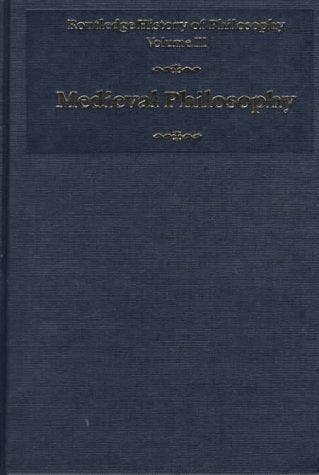
Routledge History of Philosophy, Vol. 03.. Medieval Philosophy
تاريخ روتليدج للفلسفة، المجلد الثالث.. الفلسفة الوسيطة
Histoire de la philosophie Routledge, vol. 03.. La philosophie médiévale
Medieval philosophy constitutes a rich and internally diverse tradition in which theological and metaphysical questions — above all the existence and nature of God — were pursued with rigorous argumentative methods across Christian, Islamic, and Jewish thought.
Editorial summary
This comprehensive volume examines medieval philosophy's central preoccupation with understanding God's nature, existence, and relationship to creation. Marenbon assembles contributions that trace how philosophical discourse about divinity evolved from Augustine through the late medieval period, demonstrating that the God question dominated intellectual life for over a millennium.
The collection reveals medieval philosophy as fundamentally shaped by the project of faith seeking understanding. Contributors analyze how thinkers from Boethius to Ockham developed sophisticated philosophical frameworks to address theological problems: divine simplicity, the Trinity, God's knowledge of particulars, the compatibility of divine foreknowledge with human freedom, and the demonstrability of God's existence. The volume shows how Islamic and Jewish philosophers like Al-Ghazali, Avicenna, and Maimonides enriched these debates, introducing Aristotelian tools that transformed Christian philosophical theology.
Particularly significant is the volume's treatment of the emergence of natural theology as a distinct philosophical enterprise. Essays examine how thinkers like Anselm pioneered arguments for God's existence independent of revelation, while Aquinas developed five ways of demonstrating God through reason alone. The collection traces heated disputes over whether such philosophical approaches threatened or supported faith, culminating in the condemnations of 1277 that sought to limit philosophy's autonomy from theology.
The intellectual-historical approach illuminates how medieval debates about God responded to specific institutional and cultural contexts. The rise of universities created new forums for systematic philosophical theology, while encounters with sophisticated Islamic philosophy challenged Christian thinkers to develop more rigorous rational defenses of their theistic commitments. Contributors show how seemingly abstract metaphysical disputes about divine attributes had profound implications for ethics, politics, and spirituality.
Marenbon's volume demonstrates that medieval philosophy cannot be understood apart from its theocentric orientation. Even when discussing logic, ethics, or natural philosophy, medieval thinkers consistently related these inquiries to questions about God. The collection reveals the period's philosophical richness while showing how its God-centered worldview differed radically from both ancient philosophy and modern secular thought. By presenting medieval philosophy's diverse approaches to the divine, the volume provides essential historical context for understanding how Western philosophy's engagement with theism developed over centuries of sustained reflection.
Structured analysis
Structure of the work
Argument formulations engaged
Related works
Marenbon, John (1998). Routledge History of Philosophy, Vol. 03.. Medieval Philosophy. Routledge.
@book{routledge-history-of-philosophy-vol-03-m,
  author    = {Marenbon, John},
  title     = {Routledge History of Philosophy, Vol. 03.. Medieval Philosophy},
  year      = {1998},
  publisher = {Routledge},
  url       = {https://god-database.com/en/works/routledge-history-of-philosophy-vol-03-medieval-philosophy}
}