
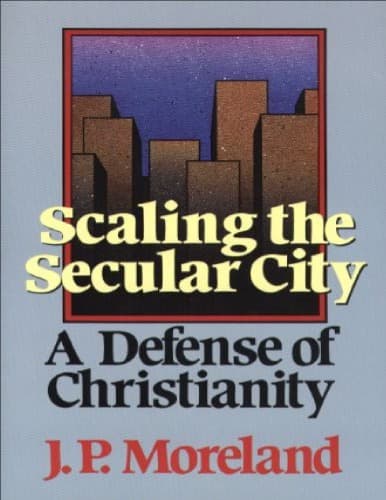
Scaling the Secular City
تسلّق المدينة العلمانية
À l'assaut de la cité séculière
Christian theism is rationally superior to secular naturalism, as demonstrated through a cumulative case drawing on cosmological, teleological, moral, and historical arguments.
Editorial summary
J. P. Moreland's "Scaling the Secular City" represents a significant contribution to late twentieth-century Christian apologetics, employing rigorous analytic philosophy to defend theistic belief against the prevailing secular worldview. The work systematically constructs a cumulative case for God's existence through multiple philosophical arguments, directly challenging naturalistic assumptions that dominated academic discourse in the 1980s.
Central to Moreland's project is the deployment of three major argument families. His treatment of the cosmological argument draws on contemporary developments in philosophy of science and cosmology, particularly engaging with the kalam cosmological argument's premise that the universe began to exist. Unlike earlier formulations, Moreland incorporates findings from Big Bang cosmology to support the argument's empirical premises while defending its philosophical foundations against infinite regress objections.
The design argument receives fresh articulation through Moreland's engagement with fine-tuning evidence and information theory. He argues that the precise calibration of physical constants and the information content in biological systems point toward intelligent design rather than chance or necessity. This approach anticipates later developments in the intelligent design movement while maintaining philosophical rigor in addressing probability calculations and alternative explanations.
Perhaps most innovative is Moreland's development of the argument from consciousness. He contends that mental properties—qualia, intentionality, and first-person subjective experience—cannot be adequately explained by physicalist theories of mind. The emergence of consciousness from purely physical processes, Moreland argues, remains inexplicable under naturalism but finds ready explanation in theism's resources for understanding mind and personhood.
Methodologically, Moreland exemplifies the Christian analytic tradition's commitment to clarity, logical rigor, and engagement with contemporary philosophy. His work bridges popular apologetics and academic philosophy of religion, making sophisticated arguments accessible while maintaining scholarly standards. The text engages seriously with objections from prominent atheist philosophers, particularly those emerging from logical positivism's decline and scientific materialism's ascendancy.
The monograph's significance lies not merely in rehearsing traditional theistic arguments but in demonstrating how analytic tools can revitalize classical apologetics for contemporary audiences. Moreland's cumulative case strategy acknowledges that while individual arguments may not prove conclusive, their combined force creates a powerful case for theism. This approach influenced subsequent Christian philosophers who similarly employed multiple converging lines of evidence rather than relying on single decisive proofs.
Argument formulations engaged
Moreland, J. P. Scaling the Secular City.
@book{scaling-the-secular-city,
  author    = {Moreland, J. P.},
  title     = {Scaling the Secular City},
  year      = {n.d.},
  url       = {https://god-database.com/en/works/scaling-the-secular-city}
}