
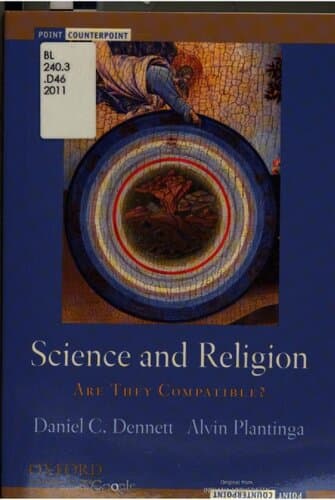
Science and Religion: Are They Compatible?
العلم والدين: هل هما متوافقان؟
Science et religion : sont-elles compatibles ?
Science and religion are either compatible or incompatible depending on whether one adopts theistic or naturalist presuppositions — a debate staged as a direct exchange between Alvin Plantinga (compatibility, theism) and Daniel Dennett (incompatibility, naturalism).
Editorial summary
Daniel Dennett's "Science and Religion: Are They Compatible?" examines the contested relationship between scientific inquiry and religious belief through rigorous philosophical analysis. While Dennett is known for his atheistic stance, this work adopts a more measured approach, exploring the compatibility question through dialogue with religious philosophers and scientists who maintain faith commitments. The monograph engages directly with contemporary defenders of theism, particularly those working within reformed epistemology who argue that religious belief can be properly basic and rationally justified without empirical evidence.
Dennett structures his analysis around three central tensions between science and religion: methodological conflicts regarding evidence and verification, explanatory competition over natural phenomena, and deeper epistemological disagreements about legitimate sources of knowledge. He examines how religious thinkers attempt to reconcile evolutionary theory with design arguments, addressing sophisticated versions of the compatibility thesis that segregate scientific and religious domains into non-overlapping magisteria. Throughout, Dennett challenges these reconciliation attempts by demonstrating how scientific methods and findings repeatedly encroach upon traditionally religious territory.
The work employs characteristic analytical precision in dissecting various compatibility proposals. Dennett examines debunking arguments that trace religious belief to evolutionary and psychological origins rather than divine revelation, while acknowledging counter-arguments from reformed epistemologists who contend that naturalistic origins need not undermine truth claims. He analyzes how modern physics, neuroscience, and evolutionary biology challenge classical theistic commitments about divine action, consciousness, and human nature. The monograph particularly scrutinizes attempts to preserve religious belief through increasingly abstract or deistic conceptions of God that avoid empirical falsification.
Dennett's contribution lies in mapping the logical geography of the compatibility debate with exceptional clarity. Rather than dismissing religious perspectives outright, he demonstrates why proposed harmonizations between science and traditional theism face severe conceptual difficulties. The work shows how scientific methodology's commitment to naturalistic explanation and empirical testing fundamentally conflicts with religious epistemology's reliance on revelation, faith, and supernatural causation. By engaging seriously with sophisticated religious philosophers while maintaining analytical rigor, Dennett provides an essential reference point for understanding why many philosophers view science and religion as ultimately incompatible, even as he acknowledges the sociological reality of their coexistence in many individuals' worldviews.
Structured analysis
Argument formulations engaged
Related works
Dennett, Daniel Science and Religion: Are They Compatible?. Oxford University Press.
@book{science-and-religion-are-they-compatible,
  author    = {Dennett, Daniel},
  title     = {Science and Religion: Are They Compatible?},
  year      = {n.d.},
  publisher = {Oxford University Press},
  url       = {https://god-database.com/en/works/science-and-religion-are-they-compatible}
}