
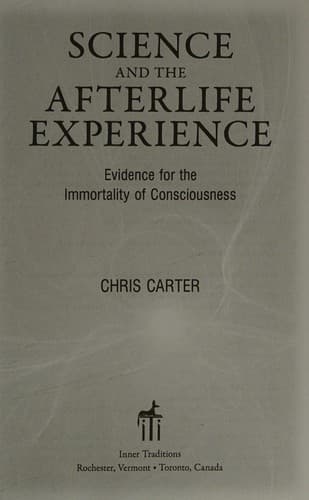
Science and the Afterlife Experience: Evidence for the Immortality of Consciousness
العلم وتجربة الآخرة: دليل على خلود الوعي
Science et expérience de l'au-delà : preuves de l'immortalité de la conscience
Editorial summary
Carter's monograph presents a systematic examination of empirical evidence suggesting consciousness survives bodily death, challenging the materialist paradigm that dominates contemporary neuroscience and philosophy of mind. The work synthesizes research from near-death experiences, apparitions, and mediumistic communications to argue that consciousness operates independently of the physical brain, thereby supporting the possibility of postmortem survival.
The author develops his argument through three interconnected strategies. First, he critiques the methodological assumptions of materialist neuroscience, particularly the axiom that consciousness emerges solely from neural processes. Carter contends this position relies on philosophical presuppositions rather than empirical necessity, echoing arguments from philosophers like David Chalmers regarding the hard problem of consciousness. Second, he presents extensive case studies from peer-reviewed research on near-death experiences, focusing on veridical perceptions during cardiac arrest when brain activity is minimal or absent. These cases, he argues, demonstrate consciousness functioning without corresponding neural correlates. Third, Carter examines historical and contemporary evidence from psychical research, including investigations of mediumship and apparitions, applying rigorous analytical frameworks to distinguish genuine phenomena from fraud or misinterpretation.
The work situates itself within ongoing debates between materialist and dualist conceptions of mind, directly engaging critics like Susan Blackmore and Paul Kurtz who attribute survival evidence to psychological or neurological mechanisms. Carter's approach combines scientific methodology with openness to non-materialist explanations, reflecting influences from researchers like Ian Stevenson and Bruce Greyson. He emphasizes that accepting evidence for consciousness survival does not require abandoning scientific rigor but rather expanding the scope of legitimate scientific inquiry.
The monograph's significance lies in its comprehensive integration of disparate research traditions typically marginalized in mainstream academic discourse. By presenting survival evidence within a coherent theoretical framework, Carter challenges the default materialism of contemporary consciousness studies. His work contributes to broader discussions about the nature of consciousness, personal identity, and the relationship between mind and brain. While not explicitly theological, the implications of consciousness surviving death intersect with religious conceptions of the soul and afterlife, making this work relevant to philosophical discussions about God, ultimate reality, and human destiny. The text serves as both a scholarly resource and an argument for reconsidering fundamental assumptions about consciousness and its relationship to physical existence.
Argument formulations engaged
Related works
Carter, Chris (2012). Science and the Afterlife Experience: Evidence for the Immortality of Consciousness.
@book{science-and-the-afterlife-experience-evi,
  author    = {Carter, Chris},
  title     = {Science and the Afterlife Experience: Evidence for the Immortality of Consciousness},
  year      = {2012},
  url       = {https://god-database.com/en/works/science-and-the-afterlife-experience-evidence-for-the-immortality-of-consciousness-2012}
}