
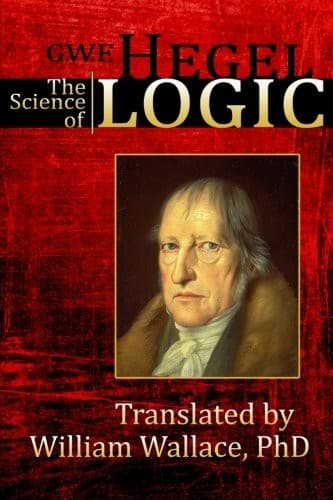
Science of Logic
علم المنطق
Science de la logique
Editorial summary
Hegel's Science of Logic represents one of the most ambitious philosophical projects in Western thought, developing a comprehensive metaphysical system that fundamentally reconceives the relationship between thought, being, and the divine. Writing in the aftermath of Kant's critical philosophy, Hegel constructs a dialectical logic that moves beyond the traditional oppositions between finite and infinite, immanent and transcendent, to articulate what he terms "absolute knowing." This work stands as the cornerstone of German Idealism's response to both Enlightenment rationalism and Romantic intuitionism, offering a radical reinterpretation of classical metaphysics and theology.
The work unfolds through three main divisions: the Doctrine of Being, the Doctrine of Essence, and the Doctrine of the Concept. Hegel demonstrates how pure being, initially conceived as immediate and indeterminate, necessarily develops through its own internal contradictions into ever more complex categorical determinations. This dialectical movement is not imposed externally but emerges from the inherent instability of each category when thought rigorously. The logic culminates in the Absolute Idea, which Hegel identifies as the unity of theoretical and practical reason, the self-thinking thought that encompasses all reality.
Central to Hegel's project is his critique of traditional conceptions of God as a transcendent being separate from the world. Against both deistic rationalism and fideistic theology, Hegel argues that the divine must be understood as the absolute that realizes itself through the finite. The logic reveals God not as a supreme being among beings but as the very process of reality's self-development and self-comprehension. This panentheistic vision challenges Kant's prohibition on metaphysical knowledge of the absolute, arguing instead that human reason participates in divine self-knowledge.
The significance of Hegel's contribution to debates about God lies in his systematic attempt to overcome the modern opposition between faith and reason. By identifying the structures of logic with the structures of being itself, Hegel provides a philosophical framework within which religious content can be given rational form without being reduced to mere human projection. His influence extends through both theological traditions that embrace his insights and atheistic philosophies that accept his critique of transcendence while rejecting his absolute idealism, making the Science of Logic a pivotal text for understanding nineteenth and twentieth century philosophical theology.
Argument formulations engaged
Related works
Hegel, Georg Wilhelm Friedrich (1812). Science of Logic. Cambridge University Press.
@book{science-of-logic-1812,
  author    = {Hegel, Georg Wilhelm Friedrich},
  title     = {Science of Logic},
  year      = {1812},
  publisher = {Cambridge University Press},
  url       = {https://god-database.com/en/works/science-of-logic-1812}
}