
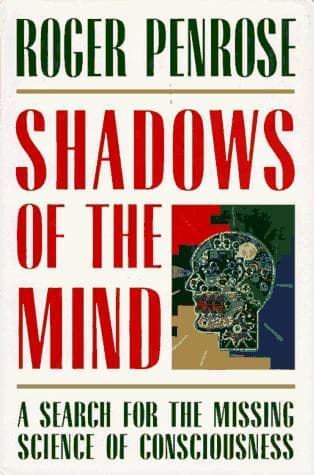
Shadows of the Mind
ظلال العقل
Les ombres de l'esprit
Editorial summary
This substantial work by mathematical physicist Roger Penrose extends his earlier arguments from "The Emperor's New Mind" to advance a controversial thesis about consciousness, quantum mechanics, and the limits of computational explanation. While not directly addressing the God question, Penrose's argument carries significant implications for debates about materialism, the nature of mind, and the possibility of transcendent aspects of reality.
Penrose contends that human consciousness cannot be fully explained by computational processes, challenging the dominant paradigm in cognitive science and artificial intelligence. He argues that Gödel's incompleteness theorems demonstrate fundamental limitations to any formal computational system, yet human mathematical understanding somehow transcends these limitations. This capacity, he maintains, points to non-computational processes in human consciousness that cannot be captured by algorithmic description.
The work's most controversial contribution involves Penrose's hypothesis about quantum processes in microtubules within neurons. He proposes that objective reduction of quantum states in these structures generates moments of consciousness, introducing a form of proto-consciousness at the fundamental level of physical reality. This position challenges both conventional materialism and computational theories of mind, suggesting that consciousness involves quantum phenomena operating at the boundary between the quantum and classical worlds.
For the God debate, Penrose's arguments provide ammunition for those who reject reductive materialism without necessarily endorsing theism. His mathematical Platonism posits a realm of mathematical truth that exists independently of human minds or physical reality, echoing classical arguments about transcendent realms of being. While Penrose himself remains uncommitted on theological questions, his framework suggests that consciousness connects to fundamental features of reality in ways that purely mechanistic accounts cannot capture.
Critics from both materialist and religious perspectives have challenged Penrose's conclusions. Materialists argue that he conflates computational limits with consciousness, while some theistic thinkers find his quantum approach insufficiently robust to ground genuine transcendence. Nevertheless, his rigorous mathematical approach to consciousness opens conceptual space for non-reductive views of mind that neither require nor preclude divine explanation.
The work's significance lies in its sophisticated challenge to physicalist orthodoxy from within the scientific establishment, demonstrating that questions about consciousness, meaning, and mathematical truth resist easy reduction to purely material explanations.
Argument formulations engaged
Related works
Penrose, Roger (1994). Shadows of the Mind. Oxford University Press.
@book{shadows-of-the-mind-1994,
  author    = {Penrose, Roger},
  title     = {Shadows of the Mind},
  year      = {1994},
  publisher = {Oxford University Press},
  url       = {https://god-database.com/en/works/shadows-of-the-mind-1994}
}