
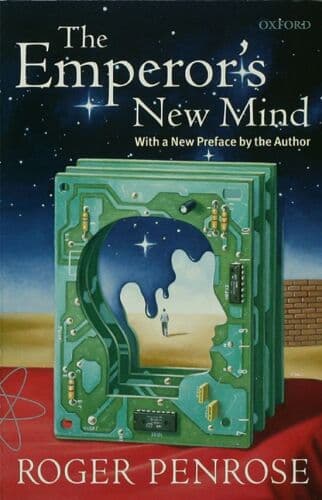
The Emperor's New Mind
عقل الإمبراطور الجديد
L'Esprit de l'empereur
Editorial summary
This monograph presents a sustained critique of computational theories of consciousness while developing an alternative framework grounded in quantum mechanics and mathematical Platonism. Penrose argues that human consciousness possesses non-computational properties that no algorithmic system can replicate, challenging the prevailing materialist assumption that minds are essentially sophisticated computers.
The work's central thesis emerges through an examination of Gödel's incompleteness theorems, which Penrose interprets as demonstrating that mathematical understanding transcends formal systems. He contends that mathematicians possess insights into mathematical truth that cannot be captured by any finite set of computational rules. This mathematical argument serves as the foundation for his broader claim about consciousness: if human mathematical understanding exceeds computation, then consciousness itself must involve non-algorithmic processes.
Penrose develops his positive account by proposing that consciousness arises from quantum processes in neural microtubules, suggesting that objective reduction of quantum states generates moments of conscious awareness. This quantum theory of mind attempts to bridge the explanatory gap between physical processes and subjective experience while preserving the irreducibility of consciousness to purely mechanical operations.
The work engages critically with strong artificial intelligence proponents and functionalist philosophers of mind who maintain that consciousness can be fully explained through computational processes. Penrose's mathematical arguments directly challenge the Church-Turing thesis as applied to mental phenomena, while his quantum proposals offer an alternative to both eliminative materialism and substance dualism.
For debates about God, the monograph provides significant though indirect contributions. Penrose's mathematical Platonism suggests a realm of objective truth existing independently of physical reality, resonating with certain natural theology arguments. His insistence that consciousness cannot be reduced to material processes challenges naturalistic explanations of mind, potentially leaving conceptual space for non-physical aspects of reality. Moreover, his emphasis on the fundamental mysteriousness of consciousness and its connection to quantum mechanics introduces elements of irreducible wonder into scientific discourse.
The work's importance lies in its rigorous scientific and mathematical challenge to reductive materialism from within the scientific establishment. By arguing that consciousness requires explanatory resources beyond conventional physics, Penrose opens pathways for dialogue between scientific and religious perspectives on the nature of mind, even while maintaining a broadly naturalistic framework. His position demonstrates that scientific investigation need not lead inevitably to materialist conclusions about consciousness and reality.
Argument formulations engaged
Related works
Penrose, Roger (1989). The Emperor's New Mind. Oxford University Press.
@book{the-emperors-new-mind-1989,
  author    = {Penrose, Roger},
  title     = {The Emperor's New Mind},
  year      = {1989},
  publisher = {Oxford University Press},
  url       = {https://god-database.com/en/works/the-emperors-new-mind-1989}
}