
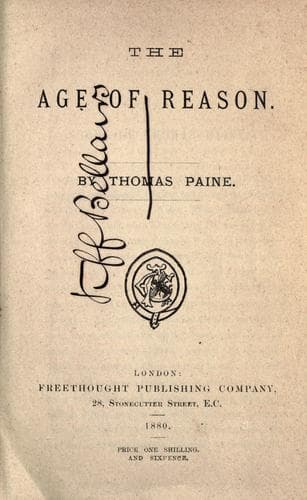
The Age of Reason
عصر العقل
L'Âge de raison
Editorial summary
Thomas Paine's The Age of Reason represents a foundational text in the development of deistic thought and religious criticism during the late Enlightenment period. Written in two parts between 1793 and 1795 while Paine faced imprisonment in France, this work systematically challenges the authority of institutional Christianity and revealed religion while maintaining belief in a creator God accessible through reason and observation of nature.
Paine employs a methodical critique of biblical texts, examining both Old and New Testaments for internal contradictions, historical inaccuracies, and moral deficiencies. His approach combines textual analysis with appeals to common sense and natural philosophy, arguing that the Bible cannot be the word of God due to its numerous errors and ethically problematic passages. He particularly targets the concepts of prophecy, miracles, and divine revelation, contending that these claims violate the principles of reason and natural law that govern the universe.
Central to Paine's argument is the distinction between natural religion and revealed religion. He advocates for a pure deism based on the observation of creation, which he views as the only authentic revelation of divine attributes. The regularity of natural laws, the complexity of the cosmos, and the evidence of design in nature constitute, for Paine, sufficient proof of a benevolent creator. This natural theology requires no mediating priesthood, no mysterious doctrines, and no suspension of rational faculties.
The work engages critically with Christian apologists and contemporary religious authorities, though Paine avoids the atheistic materialism of some French philosophes. His primary targets include the clergy's claims to special knowledge, the use of religion for political control, and the perpetuation of superstition through established churches. He argues that organized religion corrupts the pure belief in God by introducing human inventions and power structures.
The Age of Reason's significance lies in its popularization of Enlightenment religious criticism for a general audience. Unlike the more academic theological debates of his era, Paine writes in accessible prose aimed at common readers. His work contributed substantially to the growth of freethought movements in America and Europe, challenging the monopoly of Christian institutions over public discourse about God and morality. The text remains influential in discussions of religious authority, the relationship between reason and faith, and the possibility of belief in God without adherence to traditional religion.
Argument formulations engaged
Related works
Paine, Thomas (1794). The Age of Reason.
@book{the-age-of-reason-1794,
  author    = {Paine, Thomas},
  title     = {The Age of Reason},
  year      = {1794},
  url       = {https://god-database.com/en/works/the-age-of-reason-1794}
}