
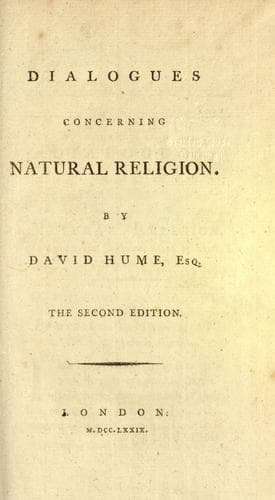
Dialogues Concerning Natural Religion
حوارات حول الدين الطبيعي
Dialogues sur la religion naturelle
Through three interlocutors representing orthodox theism, rational theology, and philosophical skepticism, Hume systematically dismantles the principal arguments of natural religion, concluding that human reason is wholly inadequate to establish any determinate conception of the divine.
Editorial summary
David Hume's Dialogues Concerning Natural Religion represents one of the most sophisticated philosophical examinations of natural theology in the Western tradition. Written in the 1750s but published posthumously in 1779, the work employs the classical dialogue form to interrogate the rational foundations of religious belief, particularly the attempt to establish God's existence and attributes through reason and empirical observation rather than revelation.
The text features three primary interlocutors: Cleanthes, who defends the argument from design using empirical evidence; Demea, who advocates for a priori demonstrations of God's existence while maintaining divine incomprehensibility; and Philo, the skeptical voice who systematically dismantles both positions. Through their exchanges, Hume examines the cosmological argument and what would later be termed the teleological argument, subjecting each to rigorous philosophical scrutiny.
Hume's method proves particularly effective in exposing the limitations of natural theology. Through Philo, he demonstrates that the argument from design, even if successful, could only establish a finite, imperfect designer whose attributes remain largely unknowable. The dialogue format allows Hume to present the strongest versions of theistic arguments through Cleanthes and Demea before revealing their fundamental inadequacies. His analysis of the problem of evil emerges as especially powerful, showing how the existence of suffering undermines any inference from the world to a benevolent, omnipotent deity.
The work's contribution to the God debate extends beyond specific arguments to challenge the entire enterprise of natural theology. Hume demonstrates that empirical observation cannot bridge the gap between finite effects and an infinite cause, while a priori reasoning fails to establish anything about existence. His critique anticipates later developments in both philosophy of religion and epistemology, influencing subsequent thinkers from Kant to contemporary philosophers of religion.
The Dialogues remains essential reading for understanding the intellectual crisis of religious belief in the Enlightenment. Hume's careful dismantling of rational theology helped establish the boundaries of religious knowledge and the limits of philosophical argument in addressing transcendent questions. His work effectively shifts the burden of proof onto those who claim rational or empirical grounds for theistic belief, establishing a skeptical framework that continues to shape philosophical discussions of religion.
Structured analysis
Argument formulations engaged
Related works
Hume, David Dialogues Concerning Natural Religion.
@book{dialogues-concerning-natural-religion,
  author    = {Hume, David},
  title     = {Dialogues Concerning Natural Religion},
  year      = {n.d.},
  url       = {https://god-database.com/en/works/dialogues-concerning-natural-religion}
}