
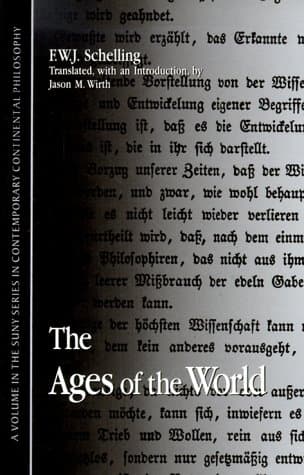
The Ages of the World
عصور العالم
Les Âges du monde
Editorial summary
Friedrich Wilhelm Joseph Schelling's The Ages of the World represents a pivotal yet problematic attempt to reconcile philosophical idealism with divine revelation. Written in 1815 but unpublished during his lifetime, this fragmentary work marks Schelling's transition from his earlier philosophy of nature to his later positive philosophy, offering a speculative account of God's self-development through cosmic history.
The text presents a radical reconceptualization of the divine as a dynamic, evolving reality rather than a static absolute. Schelling argues that God contains within Himself a primordial ground of existence that precedes His conscious self-manifestation. This ground represents an unconscious, dark principle of pure potentiality that must be overcome for God to achieve self-consciousness and freedom. The world's creation emerges not from divine decree but from God's internal struggle to liberate Himself from this unconscious nature within His own being.
Schelling develops this thesis through a unique methodological approach that combines speculative metaphysics with mystical intuition. He rejects both rationalist demonstrations of God's existence and empiricist skepticism, proposing instead a form of intellectual intuition that grasps the living movement of the absolute. This method draws heavily from Jakob Böhme's theosophy and German mystical traditions while engaging critically with his former colleagues Fichte and Hegel.
The work's significance for debates about God lies in its attempt to address the fundamental problem of divine freedom and necessity. Against traditional theism's conception of God as pure actuality, Schelling posits a God who must actualize Himself through a temporal process. This challenges both classical metaphysical proofs and Enlightenment deism by presenting divinity as inherently historical and developmental. His account also confronts the problem of evil by locating its possibility within God's own nature, thereby avoiding the difficulties of theodicy that plague conventional theism.
The Ages of the World anticipates existentialist concerns about freedom and facticity while influencing subsequent religious thought from Kierkegaard to Tillich. Its vision of a God who struggles toward self-realization offers a distinctive alternative to both anthropomorphic theism and abstract philosophical monotheism. Despite its incomplete state and obscure prose, the work remains significant for its bold attempt to think God's reality as living process rather than timeless being, fundamentally reconceiving the relationship between divinity, temporality, and creation.
Argument formulations engaged
Related works
Schelling, Friedrich (1815). The Ages of the World. State University of New York Press.
@book{the-ages-of-the-world-1815,
  author    = {Schelling, Friedrich},
  title     = {The Ages of the World},
  year      = {1815},
  publisher = {State University of New York Press},
  url       = {https://god-database.com/en/works/the-ages-of-the-world-1815}
}