
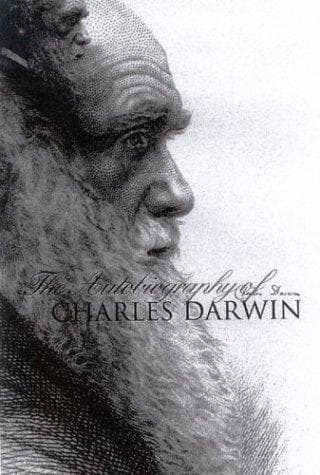
The Autobiography of Charles Darwin
السيرة الذاتية لتشارلز داروين
L'autobiographie de Charles Darwin
Editorial summary
This posthumously published autobiography offers unique insight into Darwin's evolving views on religion and the compatibility of evolutionary theory with belief in God. Written primarily in 1876 for his family, the work traces Darwin's intellectual journey from orthodox Anglican belief through increasing doubt to what he terms agnosticism, providing crucial primary source material for understanding the relationship between evolutionary science and religious faith in Victorian thought.
Darwin chronicles his gradual loss of Christian faith with remarkable candor, identifying three main factors in his religious evolution. First, his scientific work led him to reject biblical literalism, particularly regarding creation narratives and miraculous events. Second, the discovery of natural selection as a mechanism for adaptation undermined for him the traditional argument from design, which had been central to natural theology since Paley. Third, moral objections arose concerning Christian doctrines of eternal punishment and the apparent cruelty in nature, exemplified by his famous discussion of the ichneumon wasp that parasitizes living caterpillars.
The autobiography reveals Darwin's nuanced position on theism itself. While rejecting Christianity and organized religion, he maintains that the existence of God cannot be disproven and acknowledges experiencing feelings of the sublime in nature that suggest something beyond materialism. He explicitly rejects atheism as too dogmatic, preferring Huxley's term "agnostic" to describe his position. This careful distinction illuminates the complexity of Victorian scientific naturalism's relationship with religious belief.
Darwin addresses the widespread concern that evolutionary theory necessarily leads to atheism, arguing instead that scientific method simply cannot adjudicate metaphysical questions. He presents his own loss of faith as a gradual, almost involuntary process rather than a logical consequence of his scientific discoveries. This personal testimony provides essential context for interpreting his published works' careful avoidance of theological controversy.
The autobiography's discussion of variation in religious belief as a natural phenomenon prefigures later evolutionary approaches to religion itself. Darwin suggests that religious feelings vary among individuals just as other traits do, implicitly extending naturalistic explanation to domains traditionally reserved for theology. This move would prove influential for subsequent thinkers attempting to understand religion scientifically while maintaining that such understanding need not entail its falsity.
Argument formulations engaged
Related works
Darwin, Charles (1887). The Autobiography of Charles Darwin.
@book{the-autobiography-of-charles-darwin-1887,
  author    = {Darwin, Charles},
  title     = {The Autobiography of Charles Darwin},
  year      = {1887},
  url       = {https://god-database.com/en/works/the-autobiography-of-charles-darwin-1887}
}