
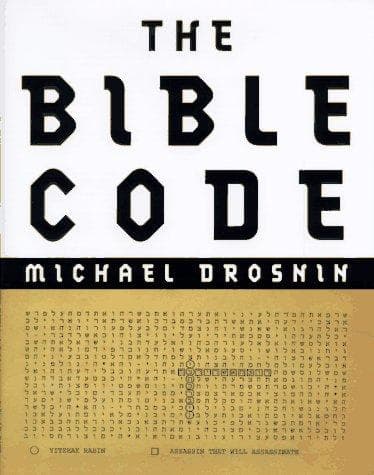
The Bible Code
شفرة الكتاب المقدس
Le Code de la Bible
Hidden equidistant letter sequences embedded in the Hebrew text of the Torah encode verifiable predictions about historical events, suggesting a superhuman or divine authorship.
Editorial summary
Michael Drosnin's The Bible Code presents a controversial investigation into alleged hidden messages encoded within the Hebrew text of the Torah. Building on the mathematical work of Israeli researchers Eliyahu Rips, Doron Witztum, and Yoav Rosenberg, Drosnin argues that the biblical text contains prophetic messages about modern events that can be revealed through equidistant letter sequences (ELS). This method involves examining the Torah as a continuous string of Hebrew letters and searching for meaningful words and phrases that appear at regular intervals when the text is arranged in grid formations.
Drosnin's approach represents a popular appropriation of scholarly research, transforming technical statistical analyses into sensational claims about divine authorship and prophecy. He contends that the Bible contains predictions of major historical events including the assassination of Yitzhak Rabin, the Gulf War, and the Holocaust. The work suggests that such precise foreknowledge embedded in ancient texts could only originate from a divine source capable of transcending temporal limitations. This argument engages traditional prophecy-based arguments for divine revelation while employing modern computational methods.
The book's methodology combines textual analysis with computer-assisted pattern recognition, though critics note significant departures from rigorous statistical protocols. Drosnin searches for convergences of thematically related terms within proximity on the grid arrangements, interpreting these clusters as prophetic messages. However, his selective presentation of results and failure to apply consistent statistical controls undermines the scientific credibility of his claims. Mathematicians and statisticians have demonstrated that similar "codes" can be found in any sufficiently long text, including War and Peace and Moby Dick.
Within the discourse on divine revelation and scripture, The Bible Code occupies a peculiar position. While ostensibly supporting supernatural claims about biblical authorship, the work's methodological flaws and sensationalist approach have made it more useful to skeptics as an example of pattern-seeking and confirmation bias. Religious authorities from Jewish and Christian traditions have largely rejected Drosnin's claims, viewing them as misunderstanding both the nature of biblical prophecy and appropriate hermeneutical methods. The book's primary contribution to the God debate lies not in advancing credible arguments for divine revelation but in illustrating how technological tools can be misapplied in service of predetermined theological conclusions, thereby highlighting the importance of methodological rigor in examining religious claims.
Structured analysis
Argument formulations engaged
Related works
Drosnin, Michael (1997). The Bible Code.
@book{the-bible-code,
  author    = {Drosnin, Michael},
  title     = {The Bible Code},
  year      = {1997},
  url       = {https://god-database.com/en/works/the-bible-code}
}