
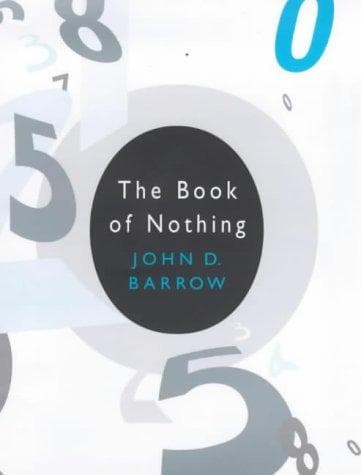
The Book of Nothing.. Vacuums, Voids, and the Latest Ideas about the Origins of the Universe
كتاب اللاشيء.. الفراغات والأعدام وأحدث الأفكار حول أصول الكون
Le Livre du rien.. Vides, vacuums et dernières théories sur les origines de l'univers
The concept of 'nothing' — from ancient vacuums to quantum fields and the cosmological void — is not a trivial absence but a scientifically and philosophically rich problem that lies at the heart of any serious account of cosmic origins.
Editorial summary
John D. Barrow's The Book of Nothing: Vacuums, Voids, and the Latest Ideas about the Origins of the Universe presents a comprehensive exploration of how the concept of nothingness has evolved from ancient philosophy through modern cosmology, with significant implications for debates about cosmic origins and divine creation. The work traces humanity's intellectual struggle with the void, demonstrating how scientific understanding of "nothing" has transformed from a philosophical abstraction into a physically meaningful concept central to contemporary cosmology.
Barrow employs a philosophy of science approach that bridges historical analysis with cutting-edge physics, examining how successive paradigms have reconceptualized emptiness. The text progresses from ancient horror vacui through medieval theology's creatio ex nihilo to quantum field theory's seething vacuum states. This methodology reveals how scientific advances have complicated rather than simplified questions about ultimate origins, particularly regarding cosmological and fine-tuning arguments for divine existence.
The work engages critically with both traditional cosmological arguments and their modern scientific reformulations. Barrow demonstrates how quantum mechanics has revolutionized understanding of the vacuum, showing that empty space teems with virtual particles and possesses measurable energy. This quantum vacuum, far from being mere absence, becomes a candidate for the primordial state from which universes might spontaneously emerge. Such findings challenge classical formulations of the cosmological argument that assume absolute nothingness as the alternative to divine creation.
Regarding fine-tuning arguments, Barrow explores how the specific properties of the vacuum state appear precisely calibrated for cosmic evolution and complexity. The cosmological constant problem exemplifies this puzzle: the observed vacuum energy density differs from theoretical predictions by 120 orders of magnitude, yet its actual value permits galaxy formation and life. While acknowledging these remarkable coincidences, Barrow maintains scientific neutrality about their theological implications.
The text's significance lies in demonstrating how scientific progress transforms rather than eliminates metaphysical questions. By showing that modern physics has made "nothing" physically substantive and potentially creative, Barrow complicates both theistic appeals to creation ex nihilo and atheistic claims about spontaneous cosmic origination. His work suggests that advancing scientific knowledge paradoxically deepens the mystery of existence, providing new contexts for ancient debates while resisting definitive theological conclusions. The book thus serves as essential reading for understanding how contemporary cosmology reconfigures but does not resolve fundamental questions about ultimate reality and its possible divine ground.
Structured analysis
Argument formulations engaged
Barrow, John D. (2000). The Book of Nothing.. Vacuums, Voids, and the Latest Ideas about the Origins of the Universe.
@book{the-book-of-nothing-vacuums-voids-and-th,
  author    = {Barrow, John D.},
  title     = {The Book of Nothing.. Vacuums, Voids, and the Latest Ideas about the Origins of the Universe},
  year      = {2000},
  url       = {https://god-database.com/en/works/the-book-of-nothing-vacuums-voids-and-the-latest-ideas-about-the-origins-of-the-universe}
}