
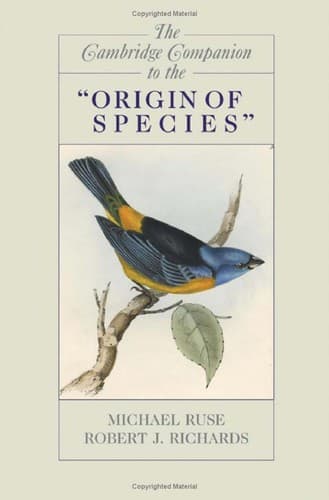
The Cambridge Companion to the 'Origin of Species'
دليل كامبريدج لـ'أصل الأنواع'
Le compagnon de Cambridge à « L'origine des espèces »
Editorial summary
This edited volume examines Darwin's Origin of Species through multiple disciplinary lenses, providing comprehensive analysis of the text's historical context, scientific arguments, and philosophical implications. Ruse assembles contributions that situate Darwin's work within Victorian intellectual culture while tracing its enduring influence on contemporary debates about evolution, design, and divine action in nature.
The collection opens with historical essays exploring the Origin's composition and reception. Contributors analyze Darwin's notebooks, correspondence, and manuscript drafts to reconstruct his theoretical development and rhetorical strategies. These chapters demonstrate how Darwin carefully navigated religious sensibilities while dismantling natural theology's design argument. The volume shows Darwin deliberately minimizing explicit discussion of human origins and divine creation to focus on natural selection's explanatory power, though contemporaries immediately grasped the theological implications.
Central chapters examine Darwin's scientific methodology and evidence. Essays detail his use of domestic breeding analogies, biogeographical distribution patterns, and morphological homologies to support descent with modification. Contributors assess how Darwin synthesized insights from Malthus, Lyell, and others while developing his unique mechanism of natural selection. The volume emphasizes Darwin's commitment to naturalistic explanation and his rejection of special creation, though several essays note his retention of theistic language in early editions.
Philosophical contributions analyze the Origin's impact on teleology, essentialism, and natural theology. Authors explore how Darwin's population thinking undermined essentialist species concepts and transformed biological explanation from divine design to algorithmic process. The volume examines tensions between Darwin's mechanism and Victorian theodicy, showing how natural selection's emphasis on struggle and extinction challenged benevolent design arguments. Essays trace how religious thinkers from Asa Gray to contemporary theologians have attempted various accommodations between evolution and theism.
The collection concludes with essays on the Origin's legacy in contemporary biology and philosophy. Contributors discuss modern evolutionary theory's elaborations and modifications of Darwin's framework while analyzing ongoing debates about evolutionary explanation and divine action. The volume demonstrates how the Origin remains central to discussions about naturalism, teleology, and the relationship between science and religion. Through careful textual analysis and intellectual history, this companion illuminates how Darwin's work fundamentally altered Western thought about nature, design, and divinity.
Argument formulations engaged
Related works
Ruse, Michael (2009). The Cambridge Companion to the 'Origin of Species'. Cambridge University Press.
@book{the-cambridge-companion-to-the-origin-of,
  author    = {Ruse, Michael},
  title     = {The Cambridge Companion to the 'Origin of Species'},
  year      = {2009},
  publisher = {Cambridge University Press},
  url       = {https://god-database.com/en/works/the-cambridge-companion-to-the-origin-of-species-2009}
}