
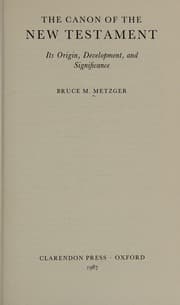
The Canon of the New Testament
قانون العهد الجديد
Le Canon du Nouveau Testament
Editorial summary
This comprehensive monograph examines the historical process through which the 27 books of the New Testament achieved canonical status within early Christianity. Metzger traces the complex development from diverse early Christian writings to the establishment of a fixed scriptural canon, analyzing the theological, ecclesiastical, and political factors that shaped this formation over several centuries.
The work meticulously documents how early Christian communities gradually distinguished authoritative texts from other religious writings. Metzger explores the criteria employed by church fathers in evaluating apostolic authenticity, orthodox content, and liturgical usage. He demonstrates that canonization emerged not through sudden ecclesiastical decree but through prolonged communal discernment, examining key figures like Irenaeus, Origen, and Athanasius who influenced the selection process. The study reveals how theological controversies, particularly with Gnostic and Marcionite groups, accelerated the need for textual boundaries.
Metzger's methodology combines textual criticism with historical analysis, drawing upon manuscript evidence, patristic citations, and ancient canon lists. He examines regional variations in canonical acceptance, noting how different geographical areas recognized varying collections before eventual convergence. The work addresses contentious books like Hebrews, James, and Revelation, whose canonical status remained disputed for centuries, alongside texts ultimately excluded despite initial acceptance in some communities.
The monograph contributes significantly to understanding religious authority and divine revelation within Christian tradition. By elucidating the human processes involved in canon formation, Metzger implicitly engages questions about the relationship between divine inspiration and ecclesiastical decision-making. His analysis reveals tensions between viewing scripture as divinely given versus humanly recognized, though he maintains scholarly neutrality regarding supernatural claims.
The work's importance extends beyond biblical studies to broader questions about religious epistemology and authority. Metzger demonstrates how communities establish textual boundaries for divine revelation, a process relevant to understanding any scripture-based religion. His careful documentation of historical contingencies in canon formation provides crucial context for contemporary theological debates about biblical authority and interpretation. The study remains foundational for scholars examining how religious communities determine and transmit what they consider divine communication, offering insights into the intersection of human history and claims to transcendent truth.
Argument formulations engaged
Related works
Metzger, Bruce M. (1987). The Canon of the New Testament.
@book{the-canon-of-the-new-testament-1987,
  author    = {Metzger, Bruce M.},
  title     = {The Canon of the New Testament},
  year      = {1987},
  url       = {https://god-database.com/en/works/the-canon-of-the-new-testament-1987}
}