
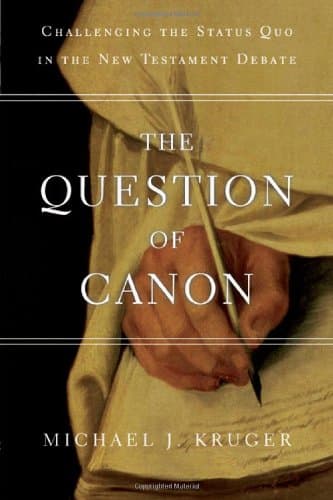
The Question of Canon: Challenging the Status Quo in the New Testament Debate
مسألة القانون: تحدي الوضع الراهن في جدل العهد الجديد
La Question du canon : Défier le statu quo dans le débat du Nouveau Testament
Editorial summary
Kruger's monograph addresses a fundamental challenge facing contemporary New Testament scholarship: the historical and theological justification for the biblical canon's boundaries. The work systematically examines how early Christian communities identified, received, and affirmed certain texts as scriptural while excluding others, offering a robust defense of the traditional Protestant canon against recent scholarly skepticism.
The author develops what he terms a "self-authenticating" model of canon formation, arguing that the New Testament books contain inherent divine qualities that early Christians recognized rather than imposed. This approach directly challenges the prevailing academic consensus, particularly the influential work of scholars like Bart Ehrman and Elaine Pagels, who portray canon formation as a late, politically motivated process driven by orthodox power struggles. Kruger contends that such reconstructions fundamentally misunderstand how early Christians conceived of scriptural authority.
Central to Kruger's argument is his critique of the "extrinsic" model of canonicity, which suggests that ecclesiastical authorities bestowed scriptural status upon texts through formal declaration. Instead, he proposes that apostolic authorship, corporate reception by early churches, and internal theological coherence served as primary criteria for recognition. The work engages extensively with patristic sources, demonstrating that second-century Christians already operated with a functional canon remarkably similar to the traditional 27-book collection.
The monograph's significance for discussions about divine revelation and religious epistemology proves substantial. By arguing that Scripture possesses self-evidencing properties, Kruger implicitly advances a particular understanding of how God communicates with humanity through written texts. This position entails specific theological commitments about divine providence, the nature of revelation, and the relationship between human recognition and divine authority.
Kruger employs a multidisciplinary methodology, combining historical-critical analysis with theological reflection and philosophical argumentation. His engagement with postmodern critiques of objective textual authority reveals the deeper epistemic issues at stake in canon debates. The work ultimately presents canon formation not as arbitrary human decision-making but as a process guided by divine intention, thereby affirming a high view of biblical authority that supports traditional Christian theism. This contribution offers conservative scholars substantial resources for defending canonical boundaries while engaging seriously with critical scholarship's historical insights.
Argument formulations engaged
Related works
Kruger, Michael J. (2013). The Question of Canon: Challenging the Status Quo in the New Testament Debate.
@book{the-question-of-canon-challenging-the-st,
  author    = {Kruger, Michael J.},
  title     = {The Question of Canon: Challenging the Status Quo in the New Testament Debate},
  year      = {2013},
  url       = {https://god-database.com/en/works/the-question-of-canon-challenging-the-status-quo-in-the-new-testament-debate-2013}
}