
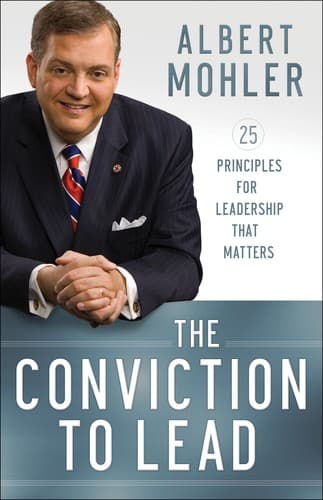
The Conviction to Lead
الاقتناع بالقيادة
La Conviction de diriger
Editorial summary
Albert Mohler's The Conviction to Lead: 25 Principles for Leadership That Matters presents a distinctively Christian approach to institutional leadership that grounds executive authority in theological conviction. Writing as president of Southern Baptist Theological Seminary, Mohler argues that effective leadership requires not merely administrative competence but deep commitment to transcendent truth claims. The work represents a significant contribution to debates about the relationship between religious belief and public leadership in contemporary pluralistic contexts.
The monograph's central thesis challenges secular leadership paradigms by insisting that conviction about ultimate reality must precede and shape organizational vision. Mohler contends that the modern separation of belief from leadership practice produces institutional drift and moral confusion. Against management theories that prioritize technique over worldview, he advances 25 principles that integrate theological commitment with practical governance. These range from the necessity of narrative frameworks rooted in biblical truth to the importance of character formation through spiritual discipline.
Mohler's methodology combines systematic theology with organizational theory, drawing extensively from Reformed Protestant sources while engaging contemporary leadership literature. His argument proceeds through careful exposition of how Christian conviction transforms standard leadership practices such as communication, decision-making, and institutional stewardship. The work explicitly positions itself against both secular leadership models that exclude religious considerations and therapeutic approaches that reduce leadership to emotional intelligence or relational skills.
The book's significance extends beyond its immediate evangelical audience to broader discussions about the role of religious conviction in public life. Mohler demonstrates how theistic assumptions about human nature, moral order, and ultimate purpose necessarily shape institutional priorities and practices. His insistence that leadership divorced from truth claims about God and reality inevitably fails provides a substantive challenge to prevailing assumptions about religious neutrality in organizational contexts.
While critics might question the feasibility of conviction-based leadership in pluralistic settings, Mohler's work offers a coherent alternative to purely procedural or pragmatic approaches. His integration of theological reflection with practical wisdom suggests possibilities for leadership models that take seriously questions of ultimate meaning and purpose. The monograph thus contributes to ongoing debates about whether effective institutional leadership requires grounding in transcendent commitments or can proceed from purely immanent considerations.
Argument formulations engaged
Mohler, Albert (2012). The Conviction to Lead. Bethany House Publishers.
@book{the-conviction-to-lead-2012,
  author    = {Mohler, Albert},
  title     = {The Conviction to Lead},
  year      = {2012},
  publisher = {Bethany House Publishers},
  url       = {https://god-database.com/en/works/the-conviction-to-lead-2012}
}