
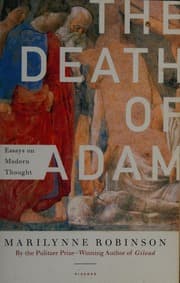
The Death of Adam: Essays on Modern Thought
موت آدم: مقالات في الفكر الحديث
La Mort d'Adam : Essais sur la pensée moderne
Editorial summary
Robinson's essay collection examines the theological dimensions of modernity through a sustained critique of secular materialism and scientific reductionism. The work challenges prevailing assumptions about the incompatibility of religious thought with intellectual rigor, arguing that contemporary culture has impoverished itself by dismissing the religious imagination. Robinson contends that modern thought, particularly in its scientific and economic manifestations, operates within unexamined metaphysical frameworks while claiming to have transcended metaphysics altogether.
The essays engage critically with evolutionary psychology, sociobiology, and economic determinism, which Robinson identifies as contemporary forms of fatalism that diminish human dignity and moral agency. She traces these intellectual currents to a misreading of both scientific method and religious tradition, arguing that genuine scientific inquiry requires the same openness to mystery and transcendence that characterizes authentic religious experience. Against writers like Richard Dawkins and Daniel Dennett, Robinson maintains that reductive materialism fails to account for consciousness, beauty, and moral experience.
Robinson's method combines close textual analysis with historical contextualization, examining how Reformation theology, particularly Calvinism, has been systematically misrepresented in academic discourse. She argues that this misrepresentation serves ideological purposes, allowing secular thinkers to construct a narrative of inevitable progress from religious superstition to scientific enlightenment. The essays demonstrate how this narrative depends upon caricatures of religious thought that ignore its intellectual sophistication and ethical insights.
The work's contribution to debates about God lies in its refusal to accept the terms typically imposed by secular criticism. Robinson argues that the question of God's existence cannot be separated from questions about human nature, moral value, and the meaning of existence. She contends that modern atheism often proceeds from an impoverished conception of what God might mean, reducing the divine to a hypothesis within a mechanistic worldview rather than engaging with the phenomenological richness of religious experience.
Throughout the collection, Robinson advocates for a recovery of theological literacy in public discourse, arguing that the absence of serious religious reflection has led to crude forms of both belief and unbelief. She positions religious thought not as an opponent to rational inquiry but as its necessary complement, providing resources for understanding human experience that purely materialist accounts cannot adequately address. The essays thus constitute both a defense of theistic humanism and a critique of the intellectual narrowness that characterizes much contemporary discussion of religion.
Argument formulations engaged
Related works
Robinson, Marilynne (1998). The Death of Adam: Essays on Modern Thought. Picador.
@book{the-death-of-adam-essays-on-modern-thoug,
  author    = {Robinson, Marilynne},
  title     = {The Death of Adam: Essays on Modern Thought},
  year      = {1998},
  publisher = {Picador},
  url       = {https://god-database.com/en/works/the-death-of-adam-essays-on-modern-thought-1998}
}