
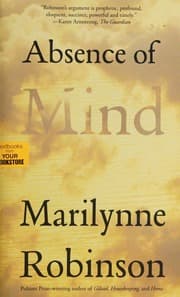
Absence of Mind: The Dispelling of Inwardness from the Modern Myth of the Self
غياب العقل: طرد الباطنية من أسطورة الذات الحديثة
Absence d'esprit : la dissipation de l'intériorité du mythe moderne du soi
Editorial summary
Robinson's monograph constitutes a vigorous defense of human consciousness against what she perceives as the reductionist tendencies of contemporary scientific materialism. The work emerges from her 2009 Terry Lectures at Yale University and represents a sustained critique of the "parascientific" literature that she argues has impoverished modern conceptions of mind, self, and human nature. While not explicitly theological in its argumentation, the text implicitly defends space for religious experience by challenging the sufficiency of purely materialist accounts of consciousness.
Robinson targets what she identifies as a pervasive cultural narrative that privileges neuroscientific explanations while dismissing the phenomenology of human inwardness. She examines influential popularizers of scientific materialism, particularly focusing on how writers like Steven Pinker, Richard Dawkins, Daniel Dennett, and E.O. Wilson have shaped public discourse about consciousness. Her critique centers on their tendency to explain away rather than explain the distinctive qualities of human mental life, including moral intuition, aesthetic experience, and religious sensibility.
The author's method combines close textual analysis of parascientific writings with broader cultural criticism. She traces how certain interpretive frameworks, particularly those derived from evolutionary psychology and neuroscience, have achieved explanatory dominance despite what she characterizes as their philosophical naivety. Robinson particularly objects to the reduction of altruism to genetic self-interest and the dismissal of subjective experience as mere epiphenomena of neural activity.
Central to Robinson's argument is her contention that the modern myth of the self paradoxically eliminates the self by reducing consciousness to mechanistic processes. She argues that this reductionism reflects not scientific rigor but rather a kind of intellectual fashion that predetermines its conclusions. The work draws on historical analysis to demonstrate how earlier thinkers, from Spinoza to William James, maintained more nuanced views of consciousness that contemporary discourse has abandoned.
The significance of this work for the God debate lies in its challenge to the epistemological monopoly claimed by scientific materialism. While Robinson does not mount a direct argument for theism, she systematically undermines the intellectual foundations of the new atheism by questioning its account of consciousness. Her defense of inwardness and subjective experience preserves conceptual space for religious belief and experience within intellectual discourse, making this an important contribution to debates about the compatibility of science and religion.
Argument formulations engaged
Related works
Robinson, Marilynne (2010). Absence of Mind: The Dispelling of Inwardness from the Modern Myth of the Self. Yale University Press.
@book{absence-of-mind-the-dispelling-of-inward,
  author    = {Robinson, Marilynne},
  title     = {Absence of Mind: The Dispelling of Inwardness from the Modern Myth of the Self},
  year      = {2010},
  publisher = {Yale University Press},
  url       = {https://god-database.com/en/works/absence-of-mind-the-dispelling-of-inwardness-from-the-modern-myth-of-the-self-2010}
}