
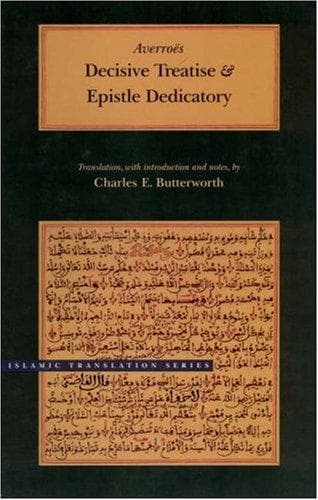
Editorial summary
This treatise presents Ibn Rushd's systematic defense of philosophy's legitimacy within Islamic law, directly addressing the conflict between religious authorities and philosophical inquiry in 12th-century Andalusia. Writing as both qadi and philosopher, Ibn Rushd constructs a legal argument demonstrating that scripture not only permits but mandates philosophical investigation for those intellectually capable of undertaking it.
The work responds to al-Ghazali's influential attack on philosophy in "The Incoherence of the Philosophers," which had severely curtailed philosophical activity in Islamic lands. Ibn Rushd employs juridical methodology to establish that the Quran itself commands the study of existence through demonstrative reasoning, citing verses that enjoin reflection upon creation. He argues that since demonstrative science provides the most certain form of knowledge, and since God commands the pursuit of knowledge about His creation, philosophy becomes a religious obligation for those with the requisite intellectual capacity.
Central to Ibn Rushd's argument is his theory of the unity of truth. He maintains that revelation and demonstration cannot genuinely conflict, as both originate from God. When apparent contradictions arise between philosophical conclusions and scriptural passages, he proposes a sophisticated hermeneutical solution: scripture possesses both apparent and allegorical meanings. The masses should accept the apparent meaning, while philosophers must pursue allegorical interpretation through demonstration.
The treatise carefully delineates three classes of people based on their intellectual capacities: the demonstrative class (philosophers), the dialectical class (theologians), and the rhetorical class (the masses). Each group has different obligations regarding scriptural interpretation, and crucially, philosophical interpretations should not be shared with those unprepared for them, as this causes social discord and undermines faith.
Ibn Rushd's contribution to the God debate lies not in proving God's existence—which he takes as established—but in legitimizing rational investigation of divine matters. By grounding philosophy in Islamic law itself, he creates space for reasoned discourse about God, causation, and the nature of existence within a religious framework. This work profoundly influenced both Islamic and Christian thought, particularly through Latin scholastics who knew Ibn Rushd as Averroes. His harmonization of reason and revelation provided a model for later thinkers grappling with the relationship between philosophy and theology, making this treatise essential for understanding medieval approaches to rational theology.
Argument formulations engaged
Related works
Ibn Rushd (1179). The Decisive Treatise. Gorgias Press.
@book{the-decisive-treatise-1179,
  author    = {Ibn Rushd},
  title     = {The Decisive Treatise},
  year      = {1179},
  publisher = {Gorgias Press},
  url       = {https://god-database.com/en/works/the-decisive-treatise-1179}
}