
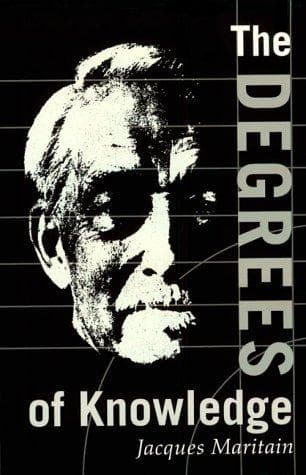
The Degrees of Knowledge
درجات المعرفة
Les Degrés du savoir
Editorial summary
This work presents a systematic neo-Thomistic epistemology that defends the compatibility of modern science with traditional metaphysical and theological knowledge. Maritain develops a comprehensive theory of knowledge that distinguishes between different orders of abstraction and their corresponding sciences, ultimately arguing for the legitimacy of supernatural knowledge alongside natural reason.
The text articulates three degrees of abstraction that structure human knowledge. The first degree encompasses the physical sciences, which abstract from individual matter while retaining sensible qualities. The second degree contains mathematics, which abstracts from sensible matter entirely. The third degree comprises metaphysics, which considers being as such. Above these natural orders, Maritain posits supernatural knowledge accessible through faith and mystical experience. This hierarchical framework allows him to acknowledge the validity of empirical science while maintaining that it represents only one limited mode of knowing reality.
Central to Maritain's argument is his critique of both scientism and idealism. Against positivist contemporaries who restrict valid knowledge to empirical verification, he contends that metaphysical and theological truths possess their own proper methods and certainty. He particularly challenges the Vienna Circle's logical positivism and Kant's critical philosophy, arguing that both arbitrarily limit reason's scope. Conversely, against idealist tendencies that would absorb all knowledge into philosophy, Maritain insists on the autonomy and value of empirical investigation within its proper sphere.
The work's significance for the God debate lies in its sophisticated defense of natural theology and religious knowledge. Maritain argues that metaphysics can demonstrate God's existence through reason alone, while revealed theology and mystical experience provide deeper knowledge of the divine nature. He develops detailed accounts of how the principle of analogy enables meaningful discourse about God despite the divine transcendence. His treatment of mystical knowledge as a legitimate form of experiential contact with God challenges both rationalist and empiricist restrictions on religious epistemology.
Maritain's contribution remains influential in contemporary discussions about the relationship between science and religion. By providing a unified framework that respects both scientific method and religious truth claims, he offers resources for those seeking to move beyond simplistic conflicts between faith and reason. His nuanced position demonstrates how traditional theistic philosophy can engage seriously with modern epistemological challenges while maintaining core religious commitments.
Argument formulations engaged
Related works
Maritain, Jacques (1932). The Degrees of Knowledge. University of Notre Dame Press.
@book{the-degrees-of-knowledge-1932,
  author    = {Maritain, Jacques},
  title     = {The Degrees of Knowledge},
  year      = {1932},
  publisher = {University of Notre Dame Press},
  url       = {https://god-database.com/en/works/the-degrees-of-knowledge-1932}
}