
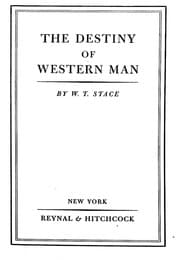
The Destiny of Western Man
مصير الإنسان الغربي
Le Destin de l'homme occidental
Editorial summary
Stace's The Destiny of Western Man examines the spiritual and philosophical crisis confronting Western civilization in the mid-twentieth century, arguing that the abandonment of religious foundations threatens the very survival of democratic values and individual freedom. Writing during World War 2, Stace diagnoses the rise of totalitarianism as symptomatic of a deeper malaise: the loss of transcendent meaning following the decline of Christian belief in Western culture.
The work develops a sophisticated philosophical argument connecting metaphysical beliefs to political and ethical structures. Stace contends that Western democracy and the concept of individual dignity rest upon specifically Christian foundations, particularly the belief in a transcendent God who grounds absolute moral values. Without this theological framework, he argues, Western societies lack the philosophical resources to resist the appeal of totalitarian ideologies that promise meaning through collective identity and state power.
Stace employs a historical-philosophical method, tracing the development of Western thought from its Christian origins through the Enlightenment to contemporary secular materialism. He argues that the Enlightenment project of preserving Christian ethics while abandoning Christian metaphysics proves ultimately unsustainable. The work engages critically with naturalistic philosophies and scientific materialism, which Stace views as intellectually coherent but spiritually devastating worldviews that cannot support the moral commitments necessary for free societies.
The monograph's significance lies in its articulation of what would become a central debate in twentieth-century philosophy of religion: whether democratic values and human rights can survive the death of God. Stace anticipates later discussions about the relationship between secularization and moral nihilism, though he writes from a position of greater cultural confidence in Christianity's intellectual credibility than would be possible in subsequent decades.
While not advancing traditional proofs for God's existence, Stace develops a pragmatic argument for theistic belief based on civilizational necessity. He contends that Western man must either recover authentic religious faith or face the collapse of the humanitarian values that distinguish Western civilization. The work represents an important contribution to mid-century debates about religion's public role, offering a philosophical defense of theism grounded not in metaphysical demonstration but in cultural diagnosis and moral urgency.
Argument formulations engaged
Stace, W. T. (1942). The Destiny of Western Man. Reynal & Hitchcock.
@book{the-destiny-of-western-man-1942,
  author    = {Stace, W. T.},
  title     = {The Destiny of Western Man},
  year      = {1942},
  publisher = {Reynal & Hitchcock},
  url       = {https://god-database.com/en/works/the-destiny-of-western-man-1942}
}