
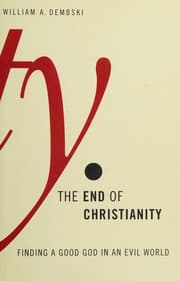
The End of Christianity: Finding a Good God in an Evil World
نهاية المسيحية: إيجاد إله صالح في عالم شرير
La Fin du christianisme : Trouver un Dieu bon dans un monde mauvais
Editorial summary
William Dembski's "The End of Christianity" presents a theodicy that attempts to reconcile biblical Christianity with the problem of natural evil by proposing a retroactive effects model of the Fall. Writing as an evangelical Christian scholar associated with the intelligent design movement, Dembski addresses what he perceives as the most formidable challenge to Christian theism: the existence of natural evil and suffering that predates human existence.
The work's central innovation lies in its temporal mechanics of sin and redemption. Dembski argues that while the Fall occurred chronologically after the creation of the universe, its effects operated retroactively, corrupting the entire space-time continuum from its inception. This allows him to maintain both a historical Adam whose sin brought death into the world and the scientific evidence for billions of years of animal suffering and natural disasters before humans appeared. He develops this through what he calls a "kairological" view of time, distinguishing between chronos (sequential time) and kairos (the order of divine action and purpose).
Dembski engages extensively with both classical theodicies and contemporary discussions. He critiques process theology and open theism as inadequate compromises that diminish divine sovereignty. Against young-earth creationists, he accepts mainstream geological and cosmological timescales while rejecting theistic evolution. He particularly targets the "cosmic fall" proposals of scholars like Michael Lloyd and argues against purely Augustinian free-will defenses as insufficient for addressing natural evil.
The monograph's significance extends beyond its specific proposal to its methodological approach. Dembski attempts to demonstrate that evangelical theology need not retreat from scientific findings about deep time and evolution's harsh mechanisms. He employs philosophical analysis, biblical exegesis, and engagement with patristic sources, particularly Gregory of Nyssa's understanding of divine foreknowledge. His retroactive causation model draws on concepts from physics and philosophy of time to construct what he presents as a biblically faithful yet scientifically informed theodicy.
This work matters to the God debate because it represents a sophisticated attempt to preserve traditional Christian doctrines about the Fall, original sin, and divine goodness while fully acknowledging the temporal extent and severity of natural evil. Critics may question whether retroactive causation creates more philosophical problems than it solves, but Dembski's proposal demonstrates the continuing vitality and creativity of classical Christian responses to the problem of evil in dialogue with contemporary science.
Argument formulations engaged
Related works
Dembski, William (2009). The End of Christianity: Finding a Good God in an Evil World. B&H Academic.
@book{the-end-of-christianity-finding-a-good-g,
  author    = {Dembski, William},
  title     = {The End of Christianity: Finding a Good God in an Evil World},
  year      = {2009},
  publisher = {B&H Academic},
  url       = {https://god-database.com/en/works/the-end-of-christianity-finding-a-good-god-in-an-evil-world-2009}
}