
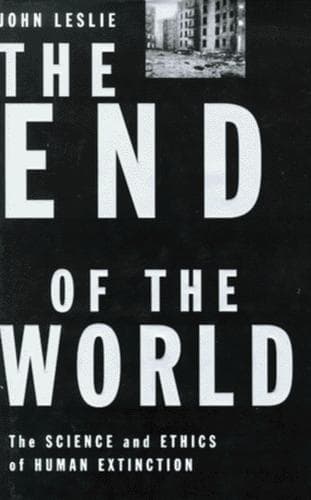
The End of the World: The Science and Ethics of Human Extinction
نهاية العالم: علم وأخلاقيات انقراض الإنسان
La Fin du Monde : La Science et l'Éthique de l'Extinction Humaine
Editorial summary
This monograph examines the probability and implications of human extinction through a rigorous philosophical analysis that combines probabilistic reasoning with ethical theory. Leslie investigates various extinction scenarios while developing a controversial argument about humanity's likely lifespan based on the "Doomsday Argument," a probabilistic reasoning that suggests humans may face extinction sooner than typically assumed.
The work's central contribution lies in its systematic application of Bayesian probability theory to existential risk assessment. Leslie employs the "Self-Sampling Assumption" to argue that our temporal position in human history provides evidence about humanity's total duration. If humans were to survive for millions of years and colonize the galaxy, our position among the first 60 billion humans would be remarkably improbable. This reasoning suggests updating our priors toward expecting a nearer extinction date, though Leslie carefully qualifies this conclusion.
Leslie examines multiple extinction risks including nuclear war, environmental collapse, biological weapons, and emerging technologies. His analysis extends beyond mere risk cataloging to explore the philosophical implications of potential human extinction. He argues that the loss of humanity would constitute an immense tragedy not merely due to individual deaths but because it would eliminate all future human value and potential. This connects to broader questions about humanity's cosmic significance and whether human consciousness represents something unique in the universe.
The work engages critically with anthropic reasoning and observation selection effects, contributing to debates about fine-tuning and the existence of God. Leslie suggests that the apparent fine-tuning of physical constants for life might be explained through observational selection in a multiverse, though he remains open to design interpretations. His treatment of these issues influenced subsequent discussions in philosophy of religion about anthropic principles and their theological implications.
Leslie's interdisciplinary approach integrates philosophy of science, probability theory, and applied ethics. He addresses objections to the Doomsday Argument while maintaining that even if the argument proves flawed, the concrete extinction risks he identifies demand serious attention. The monograph's lasting influence appears in contemporary discussions of existential risk, effective altruism, and long-termism. By combining rigorous philosophical analysis with practical concerns about humanity's survival, Leslie's work bridges academic philosophy and policy-relevant risk assessment, establishing conceptual foundations for the emerging field of existential risk studies.
Argument formulations engaged
Leslie, John (1996). The End of the World: The Science and Ethics of Human Extinction. Routledge.
@book{the-end-of-the-world-the-science-and-eth,
  author    = {Leslie, John},
  title     = {The End of the World: The Science and Ethics of Human Extinction},
  year      = {1996},
  publisher = {Routledge},
  url       = {https://god-database.com/en/works/the-end-of-the-world-the-science-and-ethics-of-human-extinction-1996}
}