
Editorial summary
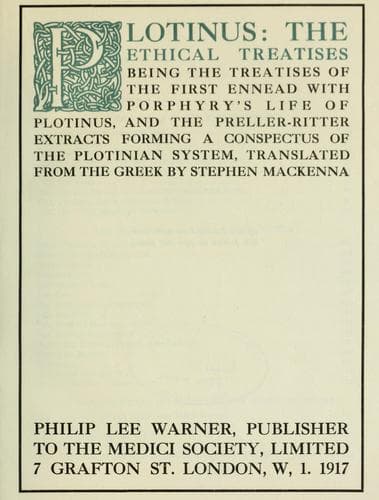
Plotinus establishes in The Enneads a comprehensive metaphysical system that profoundly shapes subsequent philosophical theology through its articulation of the One as the ultimate principle beyond being and thought. Writing in third-century Rome, Plotinus synthesizes Platonic philosophy with mystical experience to present a hierarchical cosmology where all reality emanates from a transcendent source that defies conceptualization. His work represents the culmination of Middle Platonic thought while inaugurating Neoplatonism as a distinct philosophical movement.
The text argues for the existence of an absolute first principle through a rigorous examination of unity and multiplicity in experience. Plotinus contends that the observable world's diversity necessarily derives from a prior unity, leading through logical regression to an ultimate One that transcends all categories of being. This One cannot possess attributes or consciousness in any conventional sense, as such characteristics would introduce multiplicity into its nature. From this supreme principle emanates Intellect (Nous), containing the eternal Forms, followed by Soul (Psyche), which animates the material cosmos.
Plotinus develops his position against both Aristotelian naturalism and Gnostic dualism. Against Aristotle, he maintains that the prime mover must transcend intellectual activity rather than consist in pure thought thinking itself. Against the Gnostics, he defends the inherent goodness of the material world as a necessary expression of the One's superabundant creativity, rejecting their radical separation between spiritual and physical realms.
The philosophical method combines dialectical argumentation with appeals to contemplative experience. Plotinus employs negative theology, asserting that the One can only be approached by systematically negating all positive predications. Yet he also describes mystical union with the One as the ultimate human possibility, achievable through intellectual and ethical purification.
The Enneads' significance for the God debate lies in its sophisticated articulation of divine transcendence that avoids both anthropomorphism and nihilistic negation. Plotinus provides a framework where the ultimate principle remains genuinely ineffable while grounding a rich metaphysical and ethical system. His influence extends through Augustine to Christian mysticism, Islamic philosophy, and Jewish Kabbalah, establishing apophatic theology as a crucial approach to divine reality. The work demonstrates how philosophical rigor can address ultimate questions while acknowledging the limitations of discursive reason when approaching the absolute.
Argument formulations engaged
Related works
Plotinus (270). The Enneads.
@book{the-enneads-270,
  author    = {Plotinus},
  title     = {The Enneads},
  year      = {270},
  url       = {https://god-database.com/en/works/the-enneads-270}
}