
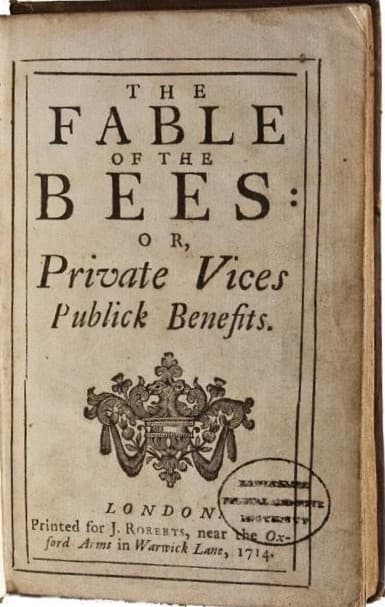
The Fable of the Bees
حكاية النحل
La Fable des Abeilles
Editorial summary
Bernard Mandeville's "The Fable of the Bees" presents a provocative challenge to conventional religious and moral philosophy through its paradoxical thesis that private vices generate public benefits. While ostensibly a work of social and economic theory, the text carries profound implications for natural theology and the problem of evil that reverberated through eighteenth-century debates about divine providence.
Mandeville constructs his argument through an allegorical poem depicting a prosperous beehive that thrives on the very vices moralists condemn. When the bees become virtuous, their society collapses into poverty and insignificance. This central paradox serves as a vehicle for examining whether the observable order of human society reflects divine design or emerges from amoral natural processes. The work systematically undermines the period's dominant physico-theological arguments, which sought to demonstrate God's existence through the apparent harmony and purposiveness of creation.
The text engages directly with Shaftesbury's optimistic deism and the Cambridge Platonists' conviction that human nature bears the stamp of divine benevolence. Against these positions, Mandeville argues that what theologians interpret as providential design actually results from the unintended consequences of self-interested behavior. His naturalistic account of moral sentiments anticipates later secular theories while challenging the period's confidence in reading divine intentions from social phenomena.
Mandeville's method combines satirical exposition with rigorous philosophical analysis, dissecting the psychological foundations of virtue to reveal their basis in pride, vanity, and social manipulation. This approach destabilizes traditional theodicies that attempt to reconcile observable evil with divine goodness. If civilization depends upon vice, then either God designed a fundamentally corrupt system, or social order emerges without divine planning.
The work's significance extends beyond its immediate context to influence subsequent discussions of natural theology. Mandeville's reduction of apparent design to mechanical processes prefigures Hume's critique of the argument from design, while his emphasis on unintended consequences anticipates evolutionary explanations that dispense with teleology. Though Mandeville formally acknowledges God's existence, his systematic naturalization of phenomena traditionally attributed to providence effectively evacuates divine action from the observable world. The text thus occupies a crucial position in the transition from Christian natural philosophy to secular social science, demonstrating how empirical analysis of human behavior could undermine rather than support religious conviction.
Argument formulations engaged
Related works
Mandeville, Bernard (1714). The Fable of the Bees. University of Chicago Press.
@book{the-fable-of-the-bees-1714,
  author    = {Mandeville, Bernard},
  title     = {The Fable of the Bees},
  year      = {1714},
  publisher = {University of Chicago Press},
  url       = {https://god-database.com/en/works/the-fable-of-the-bees-1714}
}