
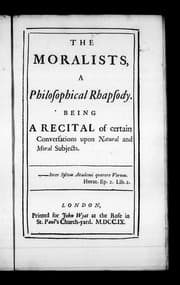
The Moralists: A Philosophical Rhapsody
الأخلاقيون: رابسودية فلسفية
Les Moralistes : Une Rhapsodie philosophique
Editorial summary
The Moralists presents Shaftesbury's mature philosophical theology through a series of dialogues that culminate in the famous "Hymn to Nature." This work advances a distinctive form of philosophical theism that grounds religious belief in aesthetic experience and moral sentiment rather than traditional metaphysical argumentation. Shaftesbury develops his position against both atheistic materialism and conventional Christian orthodoxy, seeking a middle path that preserves divine transcendence while emphasizing God's immanence in nature and human moral consciousness.
The dialogue form allows Shaftesbury to explore the relationship between natural beauty, moral virtue, and divine presence through the conversion narrative of Philocles, initially a skeptic who becomes convinced of theism through contemplation of cosmic order and natural harmony. The work's central theological argument proceeds through aesthetic intuition: the experience of beauty in nature and the recognition of moral order point toward a divine mind as their source. This approach anticipates later developments in natural theology while departing from the mechanistic arguments of contemporary physico-theology.
Shaftesbury's method combines Platonic metaphysics with Stoic ethics, presenting divinity as the animating principle of cosmic harmony rather than an external artificer. The text engages critically with Hobbes's materialism and Locke's voluntarism, rejecting both mechanical causation and arbitrary divine command as adequate foundations for morality or religion. Instead, Shaftesbury argues that human beings possess an innate moral sense that participates in divine reason, making ethical judgment and religious sentiment natural capacities rather than products of revelation or social convention.
The work's significance lies in its influential reformulation of the God-question for Enlightenment thought. By grounding theism in aesthetic and moral experience, Shaftesbury provides resources for defending religious belief against materialist critique while avoiding dogmatic supernaturalism. His emphasis on divine immanence and natural religion shapes subsequent deist thought, though his retention of transcendence distinguishes his position from purely naturalistic alternatives. The Moralists thus represents a crucial moment in the development of philosophical theology, offering a sophisticated defense of theism that integrates religious sensibility with rational reflection and moral philosophy. Its influence extends through British moral sense theory and German idealism, making it essential reading for understanding how Enlightenment thinkers reimagined the relationship between God, nature, and human experience.
Argument formulations engaged
Related works
Shaftesbury, Anthony Ashley Cooper, 3rd Earl of (1709). The Moralists: A Philosophical Rhapsody.
@book{the-moralists-a-philosophical-rhapsody-1,
  author    = {Shaftesbury, Anthony Ashley Cooper, 3rd Earl of},
  title     = {The Moralists: A Philosophical Rhapsody},
  year      = {1709},
  url       = {https://god-database.com/en/works/the-moralists-a-philosophical-rhapsody-1709}
}