
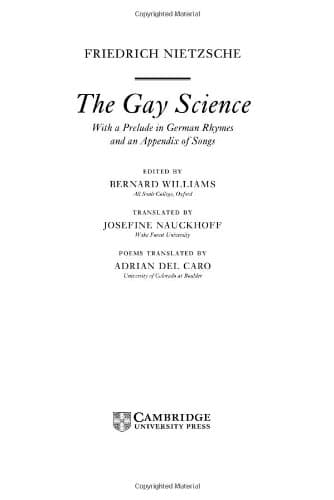
The Gay Science
العلم المرح
Le Gai Savoir
Editorial summary
This revolutionary work marks a watershed moment in Western thought about God, containing Nietzsche's most famous proclamation that "God is dead." Written in an aphoristic style that combines philosophical argument with literary artistry, The Gay Science presents a sustained critique of Christian morality and metaphysics while developing Nietzsche's vision of life-affirmation in a godless universe.
The text's central theological contribution appears in aphorism 125, where a madman announces God's death in the marketplace, declaring that "we have killed him." Nietzsche argues that the Enlightenment's critical rationality and scientific naturalism have rendered traditional theistic belief untenable for educated Europeans, though most remain unaware of this epochal shift's implications. This death of God represents not merely atheism but the collapse of the entire moral and metaphysical framework that Christianity provided Western civilization.
Nietzsche's analysis extends beyond simple rejection of theistic belief to examine the psychological and cultural consequences of divine absence. He argues that Christianity emerged from and perpetuates a life-denying attitude, privileging an imaginary afterlife over earthly existence. The work develops his genealogical method, tracing religious concepts to their origins in human psychology, particularly ressentiment and the will to power. Against Schopenhauer's pessimism and Christianity's otherworldliness, Nietzsche proposes "gay science" - a joyful wisdom that embraces existence without metaphysical consolation.
The text introduces several concepts crucial to Nietzsche's mature philosophy, including eternal recurrence, which functions as a thought experiment for affirming life without divine sanction. He critiques not only traditional believers but also secular thinkers who retain Christian moral assumptions while rejecting Christian metaphysics. The work particularly targets the complacent atheism of his contemporaries, arguing they fail to grasp the radical implications of God's absence for ethics, meaning, and value.
Nietzsche's contribution transcends simple atheistic polemics by diagnosing the cultural crisis emerging from theism's decline and proposing a creative response. His psychological insights into religious belief, analysis of Christianity's historical influence, and vision of post-theistic existence profoundly influenced subsequent philosophy, theology, and cultural criticism. The Gay Science remains essential for understanding how the "death of God" became a defining problem of modernity, challenging both believers and non-believers to confront the full implications of living in a disenchanted universe.
Argument formulations engaged
Related works
Nietzsche, Friedrich (1882). The Gay Science. Cambridge University Press.
@book{the-gay-science-1882,
  author    = {Nietzsche, Friedrich},
  title     = {The Gay Science},
  year      = {1882},
  publisher = {Cambridge University Press},
  url       = {https://god-database.com/en/works/the-gay-science-1882}
}