
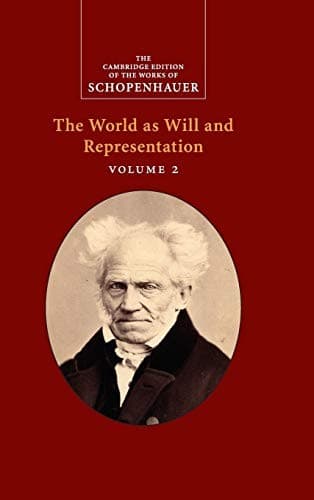
The World as Will and Representation
العالم كإرادة وتمثيل
Le Monde comme Volonté et Représentation
Editorial summary
Arthur Schopenhauer's The World as Will and Representation presents a philosophical system that fundamentally reconceptualizes the relationship between consciousness, reality, and religious meaning. Building upon Kantian epistemology while departing radically from its conclusions, Schopenhauer argues that beneath the phenomenal world of representation lies a singular metaphysical reality: the Will. This blind, irrational force manifests itself through gradations of objectification, from inorganic matter through plant and animal life to human consciousness, where it becomes aware of itself.
Schopenhauer's treatment of religion proves particularly complex. While explicitly atheistic regarding personal deity concepts, his philosophy incorporates profound insights from Eastern religious traditions, particularly Buddhism and Hinduism. He interprets religious doctrines as allegorical expressions of philosophical truths, arguing that Christianity's emphasis on redemption through denial of the will-to-live parallels his own philosophical conclusions. The work suggests that authentic religious insight consists not in theological propositions but in recognition of existence's fundamental suffering and the path to its transcendence.
The philosophical method employs a unique synthesis of Western transcendental idealism and Eastern contemplative wisdom. Schopenhauer argues against both materialist reductionism and traditional theistic metaphysics, proposing instead that aesthetic contemplation, ethical compassion, and ultimately ascetic denial offer escape from the Will's tyranny. His analysis of religious phenomena focuses on their psychological and existential dimensions rather than their truth claims, treating them as culturally specific responses to universal human suffering.
This contribution significantly influenced subsequent discussions of religion and meaning. By severing ethics from theological foundations while maintaining their absolute character, Schopenhauer creates space for non-theistic interpretations of religious experience. His pessimistic assessment of existence paradoxically leads to a quasi-mystical solution that resembles religious soteriology without requiring divine intervention. The work's impact extends through Nietzsche's critique of Christianity, psychoanalytic interpretations of religion, and comparative religious studies.
Schopenhauer's system represents a pivotal moment in Western thought's engagement with religion, demonstrating how post-Kantian philosophy could incorporate religious insights while rejecting traditional theism. His transformation of Eastern concepts into Western philosophical vocabulary opened new avenues for understanding religious phenomena beyond conventional theological frameworks.
Argument formulations engaged
Related works
Schopenhauer, Arthur (1818). The World as Will and Representation. Cambridge University Press.
@book{the-world-as-will-and-representation-181,
  author    = {Schopenhauer, Arthur},
  title     = {The World as Will and Representation},
  year      = {1818},
  publisher = {Cambridge University Press},
  url       = {https://god-database.com/en/works/the-world-as-will-and-representation-1818}
}